Brief Introduction
In logistics, warehousing, and production lines where every second counts, sorting efficiency is directly related to order fulfillment speed, operational costs, and customer satisfaction. The traditional operational model relying on paper documents, human memory, and ordinary scanning guns has long become a bottleneck constraining efficiency improvement. High error rates, information gaps, and staff fatigue... Are these pain points also troubling your operations?
Today, we will delve into a key digital tool—the industrial handheld computer (or industrial handheld terminal, data collector). It is no longer a simple "scanning gun" but has evolved into the "most powerful brain" for intelligent sorting, connecting the physical world with the data world. This article will take you directly to the pains of traditional sorting, analyze how handheld computers reshape operational workflows, and provide you with a practical selection guide.
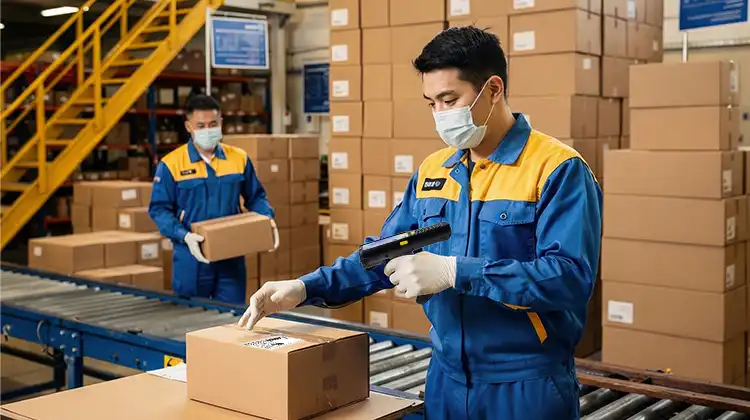
1. Targeting the Three Core Pain Points of Traditional Sorting Operations
Before introducing intelligent equipment, we must first clearly identify the problems:
Low manual operation efficiency and high error rate: Relying on manual verification and sorting is slow and highly prone to mis-sorting and missed sorting due to fatigue and distraction. Rework costs are high, affecting downstream processes.
Information flow "breakpoints," unable to achieve real-time visibility: Paper document circulation is slow, and status updates are lagging. Managers cannot grasp sorting progress, cargo location, and personnel performance in real-time. It's like "the blind men and the elephant," leading to delayed decisions.
Hardware equipment "overwhelmed": Ordinary commercial scanning devices are too fragile for industrial environments, with short battery life, unable to support high-intensity, long-term continuous scanning operations. For example, in express transfer centers, employees' daily scanning volume can reach tens of thousands. System instability often leads to work interruptions.
2. Handheld Computers: How Do They Reshape the "People, Goods, and Field" in Sorting Operations?
The emergence of handheld computers is precisely to solve the above pain points. Through digital means, they have redefined the collaborative relationship between "people," "goods," and "field" in sorting operations.
Empowering "People" - From Operators to Smart Nodes: Handheld computers intuitively display complex routing information and sorting instructions on the screen, supplemented by light and sound prompts, greatly reducing reliance on personnel experience and memory. Employees only need to "listen" to the device's guidance, achieving foolproof, zero-error operation, significantly reducing training costs and operational difficulty.
Mastering "Goods" - Full-process Data Traceability: Through high-speed, accurate barcode/QR code/RFID scanning, the full lifecycle data of each item—from inbound, putaway, picking, sorting to outbound—is collected in real-time and synchronized to the backend system. This achieves full-process visual tracking of goods, providing a data foundation for accurate inventory management, fast inventory counting, and timeliness analysis.
Coordinating the "Field" - Mobile Smart Command Center: As a mobile data terminal, the handheld computer connects scattered racks, sorting lines, and loading docks into an intelligent collaborative network. Dispatching instructions can be issued in real-time to each workstation, and abnormal situations (such as wrong scans, misplaced goods) can be reported immediately, making the entire sorting site an organic whole that responds quickly and dispatches flexibly.
3. Practical Application of Handheld Computers in Four Core Sorting Scenarios
Different industry sorting scenarios have different requirements for equipment, and handheld computer solutions are therefore customized accordingly.
3.1 Express Logistics Transfer and Sorting
Scenario Characteristics: Huge parcel volume, concentrated operation time (night shifts), complex environment (outdoor/in vehicles), extremely high scanning intensity.
Handheld Computer Value: It requires exceptional scanning performance (long-range scanning, damaged code recognition), extended battery life (supporting over 12 hours of continuous operation), and military-grade protection (drop-resistant, dustproof, waterproof). The device must be deeply integrated with the sorting system to achieve a seamless, integrated workflow of "unloading scanning, sorting path guidance, and loading verification."
3.2 E-commerce Warehouse Order Picking
Scenario Characteristics: Massive orders, numerous SKUs, need to support multiple picking modes (discrete picking, wave picking, sort-while-pick).
Handheld Computer Value: By integrating with the WMS system, it accurately guides pickers to the optimal storage location and ensures "picking the correct items in full" through scanning verification. It supports advanced functions such as voice picking (enabling hands-free operation) and vision picking (rack identification via camera), further improving personnel efficiency.
3.3 Retail Store Receiving and Inventory Counting
Scenario Characteristics: Frequent inbound receiving and acceptance inspection, inter-store transfers, and regular full-store inventory counts.
Handheld Computer Value: It enables rapid confirmation of received quantities and system inbound processing, achieving real-time updates of inventory data. During inventory counting, it can significantly shorten store closure time, improve counting accuracy, and provide a basis for precise replenishment. For industries such as apparel, its RFID functionality allows for rapid batch scanning of boxed goods, resulting in a remarkable efficiency improvement.
3.4 Factory Workshop Material and Work-in-Process Sorting
Scenario Characteristics: Associated with production work orders, must strictly adhere to First-In-First-Out (FIFO), and requires high batch traceability.
Handheld Computer Value: Ensures the right materials are delivered to the right workstations at the right time. Scanning records are linked with the MES (Manufacturing Execution System) to achieve end-to-end quality traceability and meet compliance requirements.
4. Five Key Factors in Choosing Efficient Sorting Handheld Computers
Faced with a dazzling array of products in the market, how do you choose the "most powerful brain" suitable for your business? Please focus on the following five points:
- Scanning performance is core: Pay attention to the scanning engine model, decoding capability (ability to quickly read soiled, wrinkled, on-screen barcodes), and scanning distance. This is the first hurdle determining sorting speed.
- Battery life and battery solution: Sorting operations are often high-intensity and continuous. Choose devices with large battery capacity (e.g., above 4000mAh) and Supports hot-swapping or dock charging to ensure "the device runs non-stop even when people rest."
- Industrial-grade durability: The device must pass IP65 and above protection ratings (dustproof and waterproof) and MIL-STD-810H military drop certification, able to withstand daily drops, impacts, and harsh environments (dust, rain).
- Stable operating system and manageability: Devices based on the Android system have a richer ecosystem and more flexible application development.
- Network connectivity and expandability: Stable Wi-Fi 6 connectivity ensures real-time data synchronization; 4G/5G modules guarantee communication in areas without Wi-Fi (e.g., during transportation). Consider whether expansion functions like RFID, NFC, or Bluetooth are needed based on requirements.
5. Success Case: Handheld Computers Empower Deppon Express Transfer Center to Leap in Efficiency
Theory needs validation through practice. Let's take the practice of Deppon Express, a leading comprehensive logistics service provider, as an example to see how handheld computers solve complex challenges in the real world.
As a logistics industry leader with revenue exceeding 100 billion yuan and over 5,300 directly operated outlets, Deppon Express faces extremely severe operational pressure at its transfer centers. In the loading/unloading and sorting processes, each employee's daily scanning volume can reach up to 10,000 items, placing extreme demands on the scanning equipment's battery endurance, scanning performance, and system stability. Under high-intensity, prolonged operations (often requiring continuous 12-hour runtime), the original equipment showed signs of fatigue—insufficient battery life, system lag, and even crashes—directly impacting transfer efficiency and delivery time commitments.
To break through this bottleneck, Deppon Express introduced the SEUIC AUTOID Q7-(Grip) industrial-grade handheld computer as the solution. The device was deeply optimized for logistics scenarios:
- Performance leap: Equipped with a Qualcomm high-performance processor and SEUIC's latest self-developed scanning engine, scanning performance improved by over 30% compared to the previous generation, able to handle massive parcel information quickly and accurately.
- Battery Life Revolution: Equipped with a massive 5200mAh battery, it easily meets the endurance requirements for all-weather, high-intensity operations, completely eliminating the embarrassment of equipment suffering a "premature shutdown."
- System-Level Stability: Through deep operating system customization and device management system deployment, centralized control of devices across the entire country was achieved. IT administrators can perform remote application management, system upgrades, and fault diagnosis, reducing the system failure rate of on-site equipment to nearly zero, ensuring operational continuity and stability.
Through deploying the AUTOID Q7-(Grip) in this case, Deppon Express achieved a significant result of improving overall operational efficiency by over 25% in key links such as loading/unloading and sorting. This is not just an improvement in the performance of a single device; it is, more importantly, the consolidation of the foundation for its large-scale, networked operations through stable and reliable digital tools.
In the wave of digital transformation, intelligent sorting is no longer an optional choice but a mandatory course for maintaining competitiveness. Industrial handheld computers, as the critical hub connecting physical operations and digital systems, are rightfully becoming the key driver of the sorting efficiency revolution with their powerful capabilities in data collection, processing, and interaction.
Founded in 2002, SEUIC Technologies Co., Ltd. has been committed to grasping core technologies, enhancing technological innovation, providing excellent self-owned brand products, including mobile computers, RFID readers, tablets, barcode scanners and fixed readers. With highly reliable products and efficient services, our products have been widely used in manufacturing, retail, logistics & transportation, healthcare and other industries. We provide frontline workers more durable real-time data collection tools, helping you do more thereby to catapult your productivity to the next level.
- Demystifying Manual Traceability Pains: How CRUISE2 5G Enables Barcode-Based Bidirectional Traceability2026-04-03
- Demystifying Slow Backroom Transfers: How UTouch 2-S Enables Second-Level Inventory Navigation2026-04-03
- Demystifying Quality Control Bottlenecks: How RFID Moves Towards Proactive Prevention2026-04-02
- How Handheld Computers Achieve End-to-End Traceability2026-04-02
- Demystifying Workstation Information Bottlenecks: How CRUISE2 5G Enables Paperless, Real-Time Operations2026-04-01