Brief Introduction
Imagine this: your warehouse is packed with valuable goods, but the system data never matches the actual stock. Monthly physical inventory counts require a complete work stoppage and all-night efforts, yet the results are still full of errors. Pickers walk tens of thousands of steps daily within the vast warehouse just to find a few SKUs. A best-selling item suddenly runs out of stock, while slow-moving items occupy prime storage space for a long time.
This is not just imagination; it's the daily reality for countless factory managers, warehouse supervisors, and retail operations directors. In today's world where supply chain efficiency determines corporate competitiveness, the traditional warehouse management model, reliant on manual paper-and-pen methods or basic barcodes, has become the "Achilles' heel" that hampers responsiveness, increases operational costs, and triggers customer complaints. The core pain points point directly to two key issues: invisible inventory and non-automated operations.
Fortunately, smart warehouse solutions centered on UHF RFID (Ultra-High Frequency Radio Frequency Identification) technology are becoming the "golden key" to cracking this tough nut. And the RFID reader is precisely the core execution unit that turns this key in the lock. This article will take you deep into exploring how RFID Readers, acting as the "senses" and "nerves" of the smart warehouse, drive an efficiency revolution from "man-to-goods" to "goods-to-man".
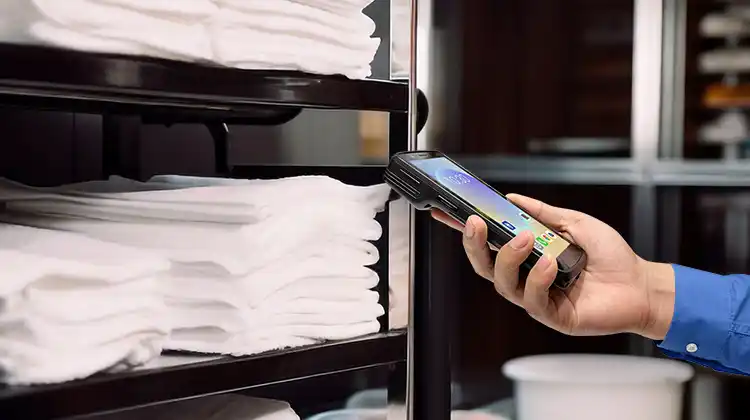
1. RFID Readers: The "Data Senses" and "Neural Terminals" of the Smart Warehouse
Before understanding the applications, we must first grasp the role RFID Readers play in the system. If each item tagged with an RFID label is a "cell" of the warehouse, then, the ubiquitous RFID readers are the keen "data senses" and efficient "neural terminals".
Data Senses: They can read the unique ID and product information (like name, specification, batch) stored in tags in a non-contact, long-distance, and batch manner. Whether goods pass by the door during inbound or are scanned by a handheld device on shelves, the readers continuously "sense" the identity and location of goods, converting physical-world "objects" into real-time digital-world "data streams".
Neural Terminals: They are responsible for executing the commands from the system's "brain" (the WMS - Warehouse Management System). For example, after the system issues a command like "move product A from location B to picking area C," the reader fixed on a forklift or AGV, or the mobile reader held by an employee, will automatically locate, verify, and feedback the task execution status, forming a closed-loop operation.
This "sense-feedback" mechanism is the physical foundation for achieving real-time inventory visibility and automated operational workflows.
2. Core Process Redefinition: Four Key Application Scenarios for RFID Readers in Warehouses
Scenario One: Lightning-Fast and Accurate Inbound, Plugging the "First Leak" in Data
Traditional Method: Unloading, unpacking, manually scanning barcodes one by one, visually checking quantities, manually entering data into the system. Time-consuming, error-prone, and fatiguing.
RFID Solution: Deploy fixed RFID Readers (like gate or tunnel types) at the receiving dock. When whole pallets or cartons of goods with RFID tags pass the dock in an instant, the readers can batch and automatically capture and verify all product information, synchronizing it in real-time to the WMS. Efficiency increases by tens of times, with nearly 100% accuracy.
Scenario Two: Smart Putaway and Storage, Making Every Item "Traceable"
Traditional Method: Relies on experienced staff memory for locations, or using RF guns to scan barcodes and then manually associate them with locations. Easy to put in the wrong place, hard to find.
RFID Solution:
Location Management: Install passive RFID tags on each rack and storage location as their "digital ID."
Smart Guidance: Employees use mobile data terminals integrated with RFID functionality. The system automatically assigns the optimal storage location. When employees place goods into the designated location, the reader on the terminal can simultaneously read the product tag and the location tag, automatically completing the binding, ensuring consistency between accounts, goods, and locations.
Scenario Three: Efficient Picking and Outbound, Bidding Farewell to "Marathon" Searches
Traditional Method: Pick list driven, "man-to-goods," long walking distances, easy to pick the wrong item.
RFID Solution:
Pick-to-Light System: Combined with fixed readers, lights automatically illuminate to indicate when goods arrive at the designated area.
RFID Picking Cart: The picking cart is equipped with a mobile reader and display. As the employee pushes the cart past racks, the onboard reader automatically identifies the required goods and lights up/beeps to prompt, while also verifying quantity. This achieves "cart-to-goods" or "goods-to-person" picking, improving picking efficiency by over 50% with near 100% accuracy.
Outbound Verification: Install fixed readers at the outbound gate, automatically verifying if outgoing goods match the order, preventing incorrect or missed shipments.
Scenario Four: Second-Level Inventory and Agile Transfer, Achieving "Dynamic Transparency" of Stock
Traditional method: Periodic (monthly/quarterly) full warehouse inventory counts, business halts, all staff are exhausted, and data can still lag behind.
RFID Solution:
Mobile Inventory: Employees walk through the warehouse holding RFID Readers, which can batch-read information for all goods within a range of several meters through shelves and packaging. An area can be inventoried in just minutes, enabling daily cycle counting. Inventory data is always online and accurate.
Fixed Inventory: Deploy fixed readers in key areas to achieve 7x24 unmanned automatic inventory and monitoring for specific zones (like high-value goods areas).
3. How to Deploy? A Guide to Selecting Fixed and Handheld RFID Readers
Choosing the right reader is key to project success. They are mainly divided into two categories:
| Type | Characteristics | Typical Application Scenarios | Selection Considerations |
| Fixed RFID Reader | Installed in fixed positions, high power, wide read range (can reach over ten meters), stable performance, often integrated with antennas. | Warehouse doors/docks (automatic inbound/outbound identification), conveyor belts/sorting lines (automatic sorting), production line workstations (process tracking), key passages (area monitoring). | Read distance, multi-tag anti-collision capability (reading hundreds of tags per second), environmental adaptability (industrial-grade protection), interfaces and protocols (easy integration with WMS/PLC). |
| Handheld RFID Reader | Flexible and portable, integrates RFID reading/writing module, Wi-Fi/4G communication, and a smart operating system (like Android). | Mobile inventory, putaway/picking operations, warehouse inspection, goods finding, internal transfers/relocation. | Battery life, ergonomic design (lightweight and drop-resistant), screen and performance, multi-function integration (need for barcode, NFC, etc.), protection rating (IP rating). |
Recommendation: A hybrid deployment is usually required.. Use fixed readers at key logistics nodes to achieve automated "data capture"; equip employees with powerful handheld RFID data terminals for areas requiring flexible manual operations.
4. Success Case Study: Witnessing How RFID Drives Warehouse Efficiency Leap - The Optik Melawai Example
The value of theory lies in practice. Let's examine the transformative impact of an RFID reader solution through a real case.
Background
Optik Melawai is one of the largest eyewear retail chains in Indonesia, with hundreds of stores selling a wide variety of high-value, diverse-style glasses. As its business expanded, its traditional manual inventory management faced severe challenges:
- Extremely low inventory efficiency: Relied on manual item-by-item counting, extremely time-consuming, seriously affecting normal store operations.
- Poor data accuracy: Frequent errors in manual recording led to distorted inventory data, affecting procurement and sales decisions.
- Poor inventory turnover: Unable to grasp real-time stock levels, leading to simultaneous stockouts of popular items and overstock of slow-movers.
- High labor costs: Frequent full inventory counts consumes significant manpower, driving up operational costs.
Solution
Optik Melawai ultimately chose an RFID-based eyewear inventory management solution. Its core hardware was the AUTOID UTouch RFID Reader.
Results
- Revolutionary acceleration in inventory counting: Leveraging the batch, long-distance reading capability of UHF RFID, the AUTOID UTouch brought revolutionary speed to inventory counting. Work that originally took hours or even longer could now be completed in an extremely short time.
- 100% data accuracy rate: RFID technology enabled precise and error-free data capture, ensuring high accuracy and reliability of inventory data, achieving "zero omissions, zero misreads," laying a solid foundation forrefined operations.
- Dual optimization of cost and efficiency: It not only significantly reduced the time and cost of manual counting, cutting losses from human error and repetitive labor, but also optimized inventory structure and accelerated inventory turnover through real-time, accurate stock data.
This case clearly shows that deploying suitable RFID Readers, whether for retail chain end warehouses or broader industrial logistics scenarios, can deliver immediate and exceptional returns in three dimensions: efficiency, accuracy, and cost.
In the wave of digitalization, warehouses are no longer static storage spaces but dynamic value hubs of the supply chain. Introducing automated identification solutions centered on RFID readers is no longer a 'nice-to-have' exploratory addition at the cutting edge; it has become a strategic 'must-have' for responding to market fluctuations, enhancing customer satisfaction, and building core competitiveness.
The benefits it brings are not just shorter counting times and fewer errors, but an upgrade of the entire warehouse operation model: from a "black box operation" reliant on manpower and experience, to a "smart organism" driven by data, real-time transparency, predictability, and optimization. For you—whether you are a decision-maker managing a factory warehouse, logistics center, or retail store backend—now is the best time to start planning this step.
Founded in 2002, SEUIC Technologies Co., Ltd. has been committed to grasping core technologies, enhancing technological innovation, providing excellent self-owned brand products, including mobile computers, RFID readers, tablets, barcode scanners and fixed readers. With highly reliable products and efficient services, our products have been widely used in manufacturing, retail, logistics & transportation, healthcare and other industries. We provide frontline workers more durable real-time data collection tools, helping you do more thereby to catapult your productivity to the next level.
- Demystifying Manual Traceability Pains: How CRUISE2 5G Enables Barcode-Based Bidirectional Traceability2026-04-03
- Demystifying Slow Backroom Transfers: How UTouch 2-S Enables Second-Level Inventory Navigation2026-04-03
- Demystifying Quality Control Bottlenecks: How RFID Moves Towards Proactive Prevention2026-04-02
- How Handheld Computers Achieve End-to-End Traceability2026-04-02
- Demystifying Workstation Information Bottlenecks: How CRUISE2 5G Enables Paperless, Real-Time Operations2026-04-01