Brief Introduction
In busy manufacturing workshops, do you often face dilemmas like these: production progress is guessed, quality traceability relies on flipping through logbooks, inventory data never matches up, and inter-departmental collaboration depends on shouting? These seemingly isolated problems often stem from delays, distortion, and fragmentation of production information. Traditional paper-based work orders and post-facto manual data entry are like layers of fog, obscuring the true situation on the production floor. This leaves every manager, from the shop floor supervisor to the plant manager, feeling like "the blind men and the elephant," making decisions without the support of real-time, accurate data.
The key to dispelling this "information fog" lies in extending the tentacles of data collection to every production link. Today, we will delve into how handheld computers (industrial handheld terminals) serve as a bridge connecting the physical world and digital systems, reshaping the tracking of "Man, Machine, Material, Method, and Environment" in production, and ultimately achieving visibility, control, and traceability of the entire manufacturing process.
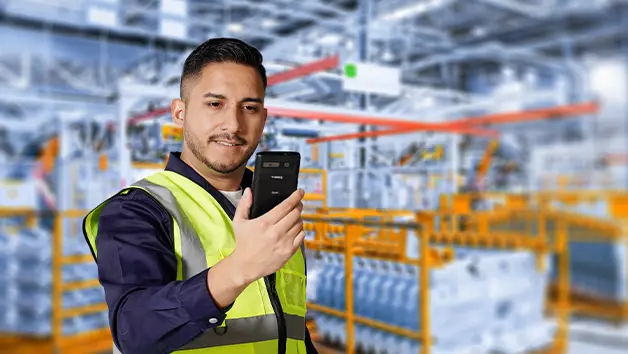
1. Facing the "Information Fog" on the Production Floor: The Four Major Pain Points of Traditional Tracking Models
Before delving into solutions, we must clearly diagnose the problem. Traditional production tracking models, whether purely paper-based or semi-electronic (paper records + manual computer entry), typically suffer from the following core pain points:
Efficiency Bottleneck, Slow Response: Paper document circulation is slow, and manual secondary data entry is time-consuming and labor-intensive, leading to severe delays in production data. When anomalies occur on the production line, information cannot be transmitted immediately, missing the best time for intervention.
Information Silos, Collaboration Difficulties: Data is not interconnected between production, warehousing, quality inspection, planning, and other departments, forming individual "information silos." Cross-departmental collaboration requires repeated communication and verification, leading to serious internal friction.
Process Black Box, Management Out of Control: Management cannot see the real-time progress, equipment status, or work-in-progress quantities on the production floor. Production planning is disconnected from actual execution, making scheduling and dispatching akin to "castles in the air."
Weak Traceability, High Quality Costs: Once product quality issues arise, reverse traceability relying on paper records is extremely difficult, taking days or even weeks. This not only slows down customer complaint handling but also makes it impossible to pinpoint the exact process link, leading to persistently high quality costs.
2. Handheld Computers: How Do They Reshape the Tracking of "Man, Machine, Material, Method, and Environment" in Production?
Industrial handheld terminals are not simple "barcode scanners." They are mobile information nodes integrating ruggedness, data collection, real-time communication, and intelligent processing capabilities. They reconstruct the management of production factors from the following five dimensions:
Man: Empowers operators with mobile workstations. Operators directly receive tasks, report work progress, declare anomalies, and perform quality checks at their workstations using handheld computers. Operations are synchronized in real-time, responsibility is assigned to individuals, improving employee efficiency and compliance.
Machine: Connects to equipment data. By scanning equipment IDs or interfacing with PLCs, it collects equipment operational status, uptime, and fault codes in real-time, providing a data foundation for predictive maintenance.
Material: Achieves full lifecycle tracking of materials. From raw material inbound, batch binding, and issuing to workshop flow, work-in-progress management, and finished goods inbound, each link involves scanning barcodes/RFID with handheld computers, ensuring accurate material information and visible location.
Method: Solidifies and optimizes process flows. Electronic Standard Operating Procedures (SOPs) are built into the terminals to guide workers in standardized operations; simultaneously, actual data from each process step is collected, providing a basis for process optimization analysis.
Environment: Expands data collection dimensions. Some high-end handheld computers can integrate environmental sensors (e.g., temperature, humidity) or be used for inspection tours, recording production environment data to ensure compliance with process requirements.
3. Four Core Application Scenarios for Handheld Computers in Production Tracking
Specifically, handheld computers play an irreplaceable role in the following key scenarios:
Production Execution and Progress Tracking: Workers use handheld computers to scan work order barcodes to start operations and scan to report completion upon finishing. Data is uploaded to the MES system in real-time, automatically updating the production progress dashboard, achieving second-level synchronization from "plan" to "execution."
Quality Inspection and Traceability Management: QC personnel use handheld computers to perform first-article inspection, patrol inspection, and finished product inspection. When non-conforming products are found, they directly scan and record defect codes, locations, and batches. All data is linked, forming a complete production traceability chain, enabling one-click reverse (from product to raw material) or forward (from raw material to product) traceability.
Warehouse and Material Management: In links such as goods receiving, putaway, picking, issuing, and inventory counting, handheld computers quickly scan material barcodes to update inventory accounts in real-time. This enables precise location management, First-In-First-Out (FIFO) control, and significantly improves inventory accuracy.
Equipment and Tool Management: Used for equipment spot checks, inspection tours, and maintenance work order processing. Scanning equipment asset tags records operational parameters, inspection results, and maintenance history. Achieves digitization and lifecycle management of equipment files.
4. The Professional Choice: How Does the SEUIC CRUISE2 5G Achieve Visibility and Control of the Entire Manufacturing Process?
To do a good job, an artisan needs the best tools. Facing complex industrial environments (oil, dust, drops, high/low temperatures) and extreme demands for real-time performance, a professional industrial handheld computer is crucial. The SEUIC CRUISE2 5G industrial handheld computer is a tool designed precisely to achieve "full-process visibility and control":
- High-Speed Network, Zero Data Delay: Supports 5G dual-mode full netcom, providing highway-like bandwidth for massive production data collection and upload, ensuring data real-time performance, truly breaking down information silos.
- Industrial-Grade Ruggedness: Passes IP68 high protection rating and 1.5-meter multiple drop certifications, fearless of harsh challenges like oil, water wash, and drops in the workshop, ensuring uninterrupted production tracking.
- Excellent Data Collection Capability: Equipped with a high-performance scanning engine, it can quickly read damaged, soiled, and high-density barcodes; RFID functionality is optional to meet batch, long-distance material identification needs.
- Powerful Performance and Battery Life: Powered by a high-performance processor and a 5000mAh large-capacity battery, it ensures smooth operation of complex applications and long-duration mobile operation, supports fast charging, and meets multi-shift production needs.
- Seamless Integration with MES/ERP Systems: Provides rich SDKs and open API interfaces, enabling quick and seamless integration with existing enterprise MES, ERP, WMS, etc., avoiding information silos.
By deploying professional equipment like the CRUISE2 5G, enterprises can build a real-time, transparent, and accurate data neural network from the shop floor to the management level, truly achieving "visibility, controllability, and traceability."
5. Success Case Witness: How Zenith Steel Utilizes Industrial Handheld Computers to Achieve Real-Time Production Data Collection and Transparent Management
Theory requires practical validation. The digital transformation practice of the large steel group Zenith Steel provides us with a highly persuasive example. Facing challenges such as slow circulation of traditional paper work orders, inefficient manual secondary data entry, and severe information barriers between departments, Zenith Steel decisively introduced a production line data collection solution centered on industrial handheld computers.
They deployed professional industrial handheld terminals at key processes and equipment points on the production line. Operators directly used handheld computers on-site to record key information for each production cycle (e.g., machine number, wet drawing tray information), with data uploaded to the central management system in real-time, completely breaking down information silos. This change brought immediate results: by building a full lifecycle traceability system, they achieved full-process data binding and traceability from raw materials to finished products. Ultimately, Zenith Steel achieved real-time production data, transparent production processes, with overall production efficiency improving by 100% compared to traditional models, and management efficiency and quality traceability capabilities also achieving tremendous leaps.
This case clearly shows that choosing the right industrial handheld terminal and implementing a comprehensive data collection solution can bring disruptive efficiency improvements and management changes to traditional manufacturing.
Digital and intelligent production tracking is no longer an "elective course" for large enterprises but a "compulsory course" for all manufacturing enterprises to enhance competitiveness and respond to market changes. As the core mobile terminal connecting the physical workshop and the digital world, handheld computers are the cornerstone for implementing production data collection, driving the effective operation of MES systems, and achieving precise production traceability. Investing in a robust and efficient handheld computer production tracking system is not just an upgrade of tools but an innovation in enterprise operational thinking and management models. It dispels the "information fog," allows data value to flow, and ultimately helps your enterprise achieve comprehensive victory in cost reduction, efficiency improvement, quality enhancement, and controllability.
Founded in 2002, SEUIC Technologies Co., Ltd. has been committed to grasping core technologies, enhancing technological innovation, providing excellent self-owned brand products, including mobile computers, RFID readers, tablets, barcode scanners and fixed readers. With highly reliable products and efficient services, our products have been widely used in manufacturing, retail, logistics & transportation, healthcare and other industries. We provide frontline workers more durable real-time data collection tools, helping you do more thereby to catapult your productivity to the next level.
- Demystifying Manual Traceability Pains: How CRUISE2 5G Enables Barcode-Based Bidirectional Traceability2026-04-03
- Demystifying Slow Backroom Transfers: How UTouch 2-S Enables Second-Level Inventory Navigation2026-04-03
- Demystifying Quality Control Bottlenecks: How RFID Moves Towards Proactive Prevention2026-04-02
- How Handheld Computers Achieve End-to-End Traceability2026-04-02
- Demystifying Workstation Information Bottlenecks: How CRUISE2 5G Enables Paperless, Real-Time Operations2026-04-01