Brief Introduction
In today's fast-paced business environment, efficiency, accuracy, and real-time visibility are central to operational success. Whether you are a plant manager optimizing production lines, a warehouse manager handling thousands of inventory items, or a retail operations director coping with high-volume sales, manual processes and outdated systems often lead to errors, delays, and cost overruns. RFID (Radio-Frequency Identification) technology is a transformative solution that uses wireless automatic identification and tracking of objects, revolutionizing industries from manufacturing and logistics to retail and healthcare. But what exactly is RFID technology? How does it work? What practical benefits can it bring to your business? More importantly, how do you select the right RFID equipment based on your specific needs? This guide serves as your comprehensive resource, answering these questions professionally and understandably, helping you make informed decisions to enhance your operations.
1. What is RFID Technology? An In-Depth Look at Core Concepts
RFID (Radio-Frequency Identification) is a wireless communication technology that uses electromagnetic fields to automatically identify and track tags attached to objects. Unlike traditional barcodes, RFID does not require a direct line of sight and can read multiple tags simultaneously from several meters away, significantly improving the efficiency and speed of data capture. A complete RFID system typically consists of three core components:
- RFID Tags: Contain a microchip and an antenna, storing unique object information. Tags are categorized as passive (rely on reader for power), active (have their own battery, can actively transmit signals), or semi-passive, suitable for different scenarios.
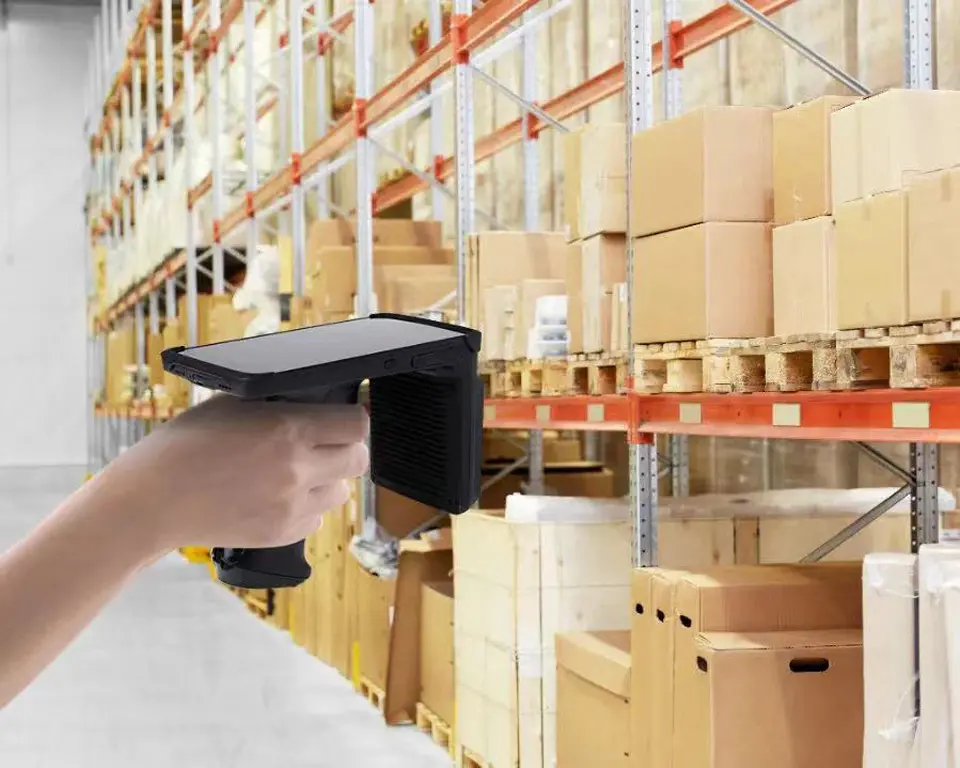
- RFID Reader: Transmits radio frequency signals via an antenna to activate tags and read/write data. Readers can be fixed (e.g., at warehouse doors) or handheld/mobile.
- Antenna and Software System: Antennas enhance signal transmission, while software (e.g., inventory management systems) processes data to provide actionable insights.
RFID technology is not new—it originated in World War II radar systems but has seen widespread adoption in recent years due to decreasing costs and the development of the Internet of Things (IoT). From tracking parts in manufacturing to managing inventory in retail, RFID offers unprecedented automation and real-time visibility. For instance, in logistics centers, RFID can monitor package locations in real time, reducing loss and delays; in hospitals, it ensures the security and availability of medical equipment.
2. How Does an RFID System Work? A Step-by-Step Breakdown
Understanding how an RFID system works hinges on its wireless communication process. This isn't just a technical detail; it's the foundation for operational optimization. Here are the typical steps, illustrated with practical scenarios:
- Tag Activation: The RFID reader emits a radio frequency signal of a specific frequency via its antenna. When a tag enters the signal range, passive tags harvest energy from the signal, while active tags use their built-in battery to activate the chip.
- Data Exchange: The activated tag sends back its stored data (e.g., serial number, production date, location) to the reader via backscatter modulation. This process completes within milliseconds and supports batch reading. For example, an entire pallet of goods can be scanned instantly during warehouse receiving, eliminating the need for item-by-item processing.
- Data Processing: The reader receives the data, which is then filtered and validated by middleware software before being integrated into enterprise systems (e.g., ERP or WMS). This allows managers to view inventory levels in real time, track assets, or automate processes.
The operating frequency of the RFID system also affects performance:
- Low Frequency (LF, 125-134 kHz): Short read range (a few centimeters), strong interference resistance, suitable for animal tracking or access control.
- High Frequency (HF, 13.56 MHz): Medium range (approx. 1 meter), commonly used in libraries, payment cards, and medical device management.
- Ultra-High Frequency (UHF, 860-960 MHz): Long read range (up to 10+ meters), strong batch processing capability, ideal for logistics, retail, and industrial applications.
3. Key Advantages of RFID Technology: Why Industry Leaders Are Adopting It
The benefits of RFID technology extend far beyond automation; it drives comprehensive improvements in operational efficiency, cost savings, and customer satisfaction. Based on industry practices, here are its main benefits:
- Enhanced Accuracy and Efficiency: Traditional manual inventory counts can have an error rate of 5-10%, whereas RFID increases accuracy to over 99%. For example, retail chains using RFID have reduced inventory counting time from hours to minutes, allowing staff to focus on value-added tasks.
- Real-Time Visibility and Traceability: From raw materials to finished goods, RFID provides end-to-end tracking. In healthcare, this ensures compliance for pharmaceuticals and devices; in logistics, it reduces package loss and improves delivery reliability.
- Cost Reduction: By reducing manual labor, minimizing overstock, and preventing theft, RFID can significantly lower operational costs. Studies show that warehouses using RFID can reduce labor costs by up to 30%.
- Improved Security and Compliance: In government or utility sectors, RFID is used for asset tracking and field inspections, ensuring regulatory adherence. For instance, power companies use RFID to monitor meters and prevent tampering.
- Support for Automation and Innovation: Integration of RFID with IoT and AI enables advanced applications like predictive maintenance. In e-commerce fulfillment centers, it realizes the vision of "unmanned warehouses," speeding up order processing.
4. How to Select RFID Equipment for Different Solutions: A Practical Guide
Selecting RFID equipment is not a one-size-fits-all approach; it depends on your specific application, environment, and budget. As a professional, you need to evaluate the combination of tags, readers, and software to ensure solution viability and scalability. Here is a step-by-step guide based on common scenarios to aid your decision-making:
4.1 Define Your Business Needs and Scenario
First, identify the core problem RFID will solve. Examples:
- Manufacturing/Warehouse Management: Focus on tracking high-value assets or bulk inventory. Prioritize durable, metal-mount UHF tags and fixed readers for portal monitoring.
- Retail/Supermarket: Aim for inventory accuracy and loss prevention. HF or UHF tags are suitable for apparel or electronics, combined with handheld readers for floor checks.
- Healthcare/Clinic: Emphasize compliance and patient safety. Use medical-grade HF tags for tracking equipment, integrated with hospital management systems.
- Logistics/3PL: Require high-speed, long-range reading. UHF systems and portal readers are ideal for sorting and shipping.
- Utilities/Government: Target outdoor and harsh environments. Choose active tags and rugged readers supporting remote monitoring.
4.2 Select the Appropriate RFID Tag Type
Tags are the foundation of the solution; consider:
- Passive Tags: Low cost, long lifespan, suitable for most inventory tracking (e.g., retail goods). Limited read range.
- Active Tags: Self-powered, support real-time GPS-like tracking, ideal for high-value assets or large areas (e.g., port containers). Higher cost.
- Material Compatibility: Metal or liquid environments require specialized tags (e.g., on-metal tags) to avoid signal interference.
4.3 Evaluate Readers and Antennas
Readers determine data capture capability:
- Fixed Readers: Used for portals or conveyor belts, providing continuous monitoring. Suitable for automated warehouses or retail exits.
- Handheld Readers: Mobile and flexible, ideal for field inspections or inventory counts. E.g., delivery personnel use handhelds to verify packages.
- Antenna Selection: Linear antennas for long-range; circularly polarized antennas for multi-directional reading. Match frequency (UHF for most industrial apps) for performance.
4.4 Integrate Software and Support
The core of an RFID solution is software integration. Choose scalable platforms that seamlessly connect with your existing ERP, WMS, or cloud systems. Partner with a reliable RFID solutions provider to ensure technical support, training, and updates.
RFID technology is more than just a tool; it is a strategic asset driving operational excellence. By understanding what RFID technology is, how RFID systems work, and their multiple benefits, you can begin planning your implementation. The key is selecting the right RFID equipment based on your industry needs—be it manufacturing efficiency, retail accuracy, or logistics visibility. Remember, a successful RFID solution starts with clear business objectives and professional equipment selection.
- Demystifying Manual Traceability Pains: How CRUISE2 5G Enables Barcode-Based Bidirectional Traceability2026-04-03
- Demystifying Slow Backroom Transfers: How UTouch 2-S Enables Second-Level Inventory Navigation2026-04-03
- Demystifying Quality Control Bottlenecks: How RFID Moves Towards Proactive Prevention2026-04-02
- How Handheld Computers Achieve End-to-End Traceability2026-04-02
- Demystifying Workstation Information Bottlenecks: How CRUISE2 5G Enables Paperless, Real-Time Operations2026-04-01