Brief Introduction
As a key link in breaking down information silos in production, warehousing, logistics and other processes, the suitability of data collection equipment directly affects the smoothness of production rhythm and the accuracy of cost control. Equipment such as handheld terminals, RFID readers, barcode scanners, industrial barcode readers, and industrial tablets each have their own focus. When selecting equipment, it is necessary to closely integrate the task requirements, environmental characteristics and operation modes of the scenario. So how should manufacturing enterprises choose the right equipment? Today, SEUIC will analyze from aspects such as core equipment characteristics, typical application scenarios, advantages and disadvantages.
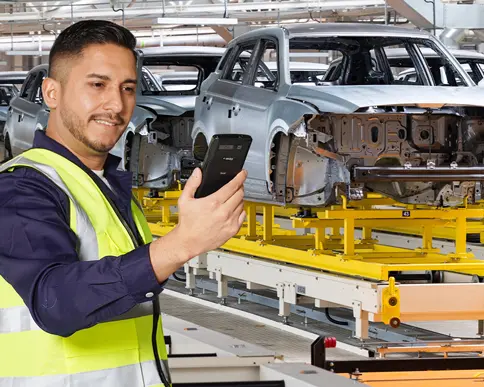
1. Handheld Terminals: Multifunctional Smart Platforms for Mobile Scenarios
1.1 Core Functions: Mobile smart computers with integrated barcode scanning function, built-in Android or Windows operating system, with data processing capability, can install customized business APPs such as WMS and MES, support wireless communication such as WiFi, 4G/5G, Bluetooth, etc., able to achieve business closed loop of "scanning-input-processing-uploading", also support keyboard input, touch screen operation, camera, GPS positioning, etc.
1.2 Application Scenarios: Suitable for all scenarios requiring mobile operation, such as mobile inventory counting, shelving, picking, stock transfer in warehouses; work-in-process tracking, material distribution, labor reporting on production lines; equipment inspection and maintenance records; on-site quality management and defect recording, etc.
1.3 Advantages and Disadvantages: The advantage is high functional integration, capable of independently completing the entire business process operation, strong mobility, good protection level and anti-drop performance; the disadvantage is that the cost is higher than barcode scanners, and it is over-functional for fixed scenarios that only require simple scanning.
SEUIC CRUISE2 5G industrial-grade handheld terminal is equipped with Qualcomm octa-core 2.0GHz high-performance processor, paired with UFS 2.1 high-speed flash memory, data reading and writing speed is 2-3 times higher than the previous generation, power consumption reduced by 35%. The device adopts advanced Wi-Fi6 technology, transmission rate up to 1.2Gbps, 39% faster than mainstream Wi-Fi 5, network capacity increased by 2-3 times, supports concurrent operation of multiple applications. Its 5G module performance is 10% higher than similar devices in weak signal environments, download speed nearly 10 times faster than 4G. At the same time, equipped with a new generation E710 radio frequency engine, supports reading speed of 1300 tags per second, maximum identification distance up to 20 meters. The device passes IP67 protection level certification, can withstand 1.8 meter drop to cement ground, operating temperature range -20°C to 50°C. 11700mAh dual battery design supports hot swap, ensuring 24-hour uninterrupted operation. The technology can intelligently identify complex barcodes such as dirty, bent, low contrast, etc. Especially suitable for mobile scenarios such as logistics sorting, warehouse inventory, retail inspection, etc., perfectly adapted to manufacturing MES, WMS system integration, achieving real-time data synchronization and process automation.
2. RFID Readers: Efficiency Improvement Tools for Batch Identification Scenarios
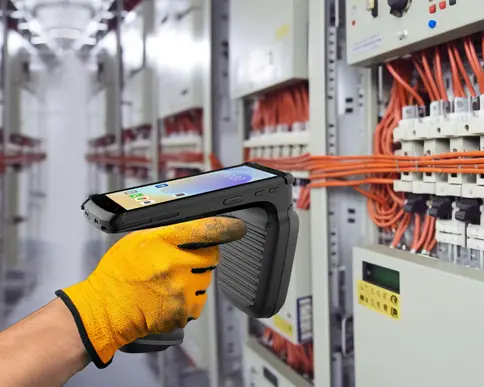
2.1 Core Functions: Terminal equipment integrated with RFID reading and writing modules, handheld RFID readers have all functions of handheld terminals (smart system, barcode scanning, mobile processing), added UHF or HF RFID reading/writing capability, can contactless, batch identify RFID tags, no need for alignment, can penetrate non-metallic packaging to read internal tags.
2.2 Application Scenarios: Including quick inbound/outbound inventory counting of whole pallets, whole cases of goods in warehouses (no need to unpack and scan codes one by one); batch tracking of work-in-process on production lines (installed in containers or vehicle bodies); positioning and management of important factory assets (tools, equipment, returnable containers); also supports mixed scenarios requiring both barcode and RFID, etc.
2.3 Advantages and Disadvantages: The advantage is high batch identification efficiency, contactless operation, can handle scenarios where barcodes are inconvenient to use; the disadvantage is that RFID tag cost is higher than barcodes, identification performance may be affected in metal environments, and the equipment itself costs more than ordinary handheld terminals.
SEUIC AUTOID UTouch 2 adopts Qualcomm octa-core 2.0GHz processor, equipped with Android 11 operating system. The device integrates IFJ new generation E710 radio frequency engine, UHF RFID reading speed up to 1300 tags/second, maximum identification distance 20 meters. Supports temperature sensing, LED prompt, UPC and other special tag reading. At the same time, supports Wi-Fi6 and 5G dual-mode connection, transmission rate increased by 39%, network capacity increased by 2-3 times. Equipped with 5000mAh+6700mAh dual battery architecture, total capacity 11700mAh, supports hot swap uninterrupted power supply. IP67 protection level ensures stable operation in dust, water drop environments, operating temperature range -20°C to 50°C. Designed for logistics, manufacturing, retail and other industries, supports batch inventory, asset tracking, supply chain management and other scenarios, can be seamlessly integrated with existing ERP, WMS systems.
3. Barcode Scanners: Economical Choice for Basic Scanning Scenarios
3.1 Core Functions: Quickly read 1D barcodes and 2D QR codes, no independent data processing capability, need to connect to host (such as computer, POS) via wired or wireless way for data transmission.
3.2 Application Scenarios: Suitable for simple scanning scenarios in fixed workstations, such as scanning material labels at production line workstations to complete labor reporting or tracing; scanning documents or outer case labels during warehouse receipt/shipment; quickly recording product information in quality inspection links, etc.
3.3 Advantages and Disadvantages: The advantages are low cost, simple operation easy to use, outstanding portability; the disadvantages are single function, reliance on connected computer or handheld terminal host to operate, unable to independently complete data processing.
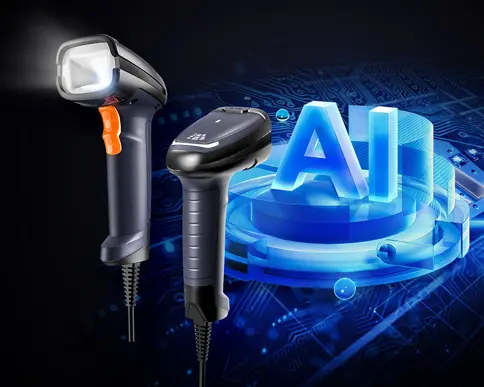
SEUIC HS305DP adopts AI image processing algorithm, equipped with dual-core processor, can identify DPM barcodes (Direct Part Marking) in milliseconds, effectively dealing with complex scenarios such as metal surfaces, bending, low contrast. Three-color intelligent fill light system automatically adapts to different materials and backgrounds, improving recognition success rate. At the same time, the device supports IP65 protection level, withstands dust, liquid splashing in industrial environments. Ergonomic design reduces fatigue during long-term operation, cable can be detached without tools, plug and play. Compatible with various interfaces such as USB, Bluetooth, etc. Designed for manufacturing production lines, warehouse receipt, quality inspection links, can be seamlessly integrated into MES, QMS systems, achieving quality traceability and process control.
4. Industrial Barcode Readers: Professional Solution for Complex Barcode Environments
4.1 Core Functions: Designed for challenging barcode reading environments, can efficiently handle dot peen marks, laser etching marks on metal/plastic parts, tiny codes, dirty/damaged codes, and barcodes on high-speed moving objects. Protection level usually reaches IP65/IP67 or above, available in fixed and handheld forms.
4.2 Application Scenarios: Focus on industries and links with extremely high requirements for code reading, such as reading component DPM codes in automotive, aerospace fields; barcode reading on high-speed production lines (like filling lines) in food beverage, pharmaceutical industries; identifying tiny barcodes on PCB boards in electronics industry; code reading operations in harsh environments like dust; unmanned fixed scanning points in automated production lines, etc.
4.3 Advantages and Disadvantages: The advantage is strong code reading ability, strong environmental adaptability; the disadvantage is that compared to barcode scanners, the cost is higher, functions are highly targeted, cost-effectiveness not prominent in simple scanning scenarios.
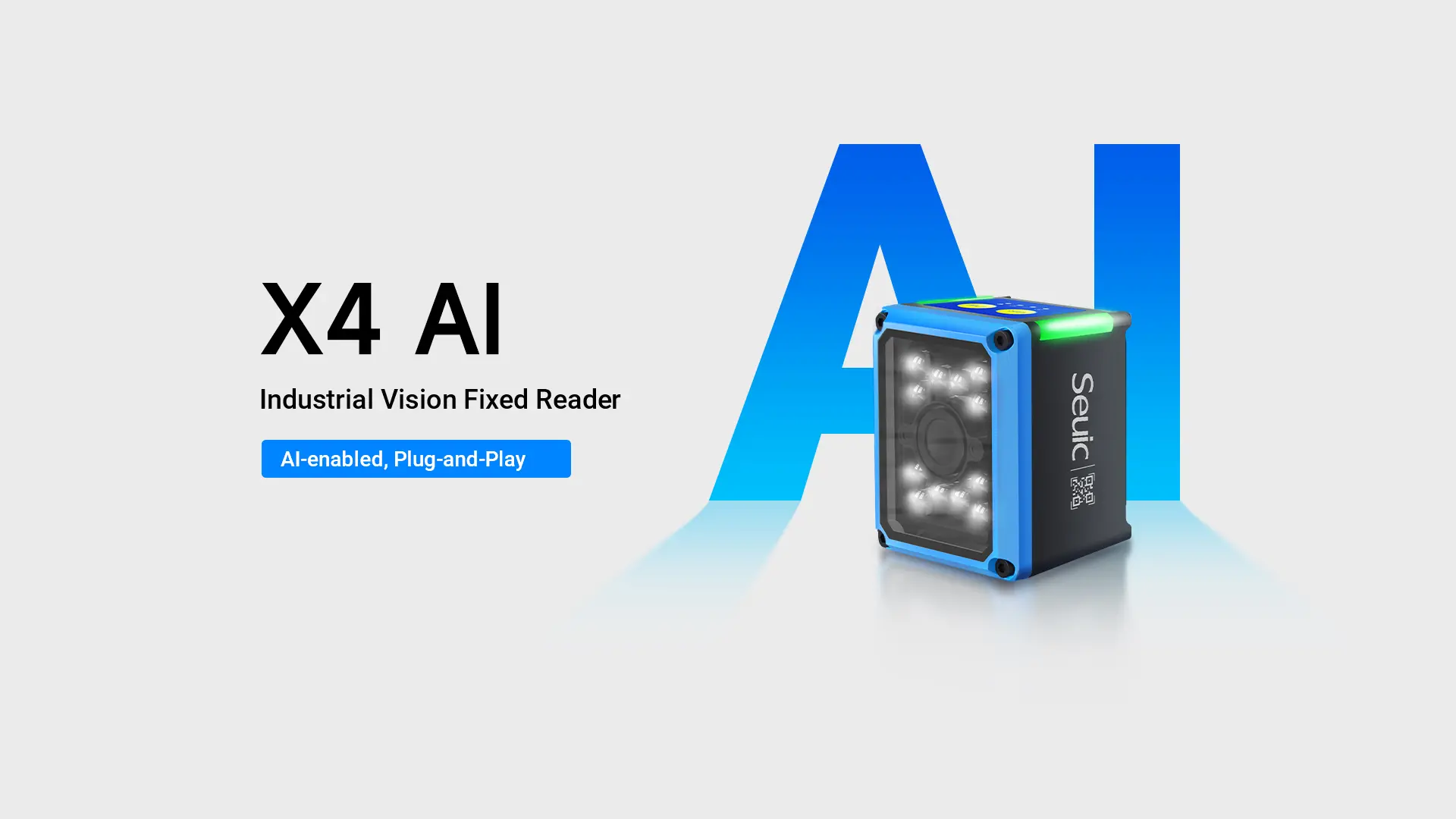
SEUIC X4 AI industrial barcode reader is equipped with 1.3-megapixel CMOS sensor, features global shutter, can read 1D barcodes as small as 3.3mil and 2D codes as small as 2.0mil. Auto-focus system supports reading distance adjustment from 50mm to 450mm, identification speed only 3 milliseconds. Red-blue dual-color LED lighting system improves recognition rate in complex environments. At the same time, supports various industrial protocols such as TCP Client, Profinet, Ethernet/IP, provides 3 channels of optocoupler output control. IP65 protection level ensures stable operation in 0°C to 50°C environment, withstands harsh conditions like dust, humidity. Compact design 61.2x48.7x43.8mm suitable for space-limited installation environments. Suitable for automated production lines in automotive manufacturing, electronic assembly and other industries, can accurately read component DPM codes, trace product quality information.
5. Industrial Tablets: High-performance Equipment for Strong Interaction Scenarios
5.1 Core Functions: Rugged tablets with large-size touch screen, high-performance computing capability and rich industrial interfaces, running complete Android/Windows operating system, can integrate or externally connect data collection modules like barcode, RFID, etc., support wall mount, bracket fixation or vehicle mounting use.
5.2 Application Scenarios: Suitable for scenarios requiring large screen interaction, such as production line control console displaying production information, operation guidance and quality kanban; equipment monitoring console visually displaying operation status, parameters and alarm information; viewing drawings, video guidance at complex assembly/maintenance workstations; forklift vehicle-mounted terminal for logistics navigation and task scheduling, etc.
5.3 Advantages and Disadvantages: The advantages are large screen, strong interactivity, strong computing performance, rich interfaces便于连接多种外设, good adaptability to fixed workstations; the disadvantages are slightly weak portability, high cost, not suitable for lightweight operation scenarios requiring frequent movement.
SEUIC AUTOID Pad Air 5G is equipped with 10.1-inch high-brightness display, supports operation with gloves and wet hands. Equipped with octa-core processor, supports 5G and Wi-Fi6 connection, ensures stability of large data volume transmission. Battery life up to 12 hours, supports fast charging technology. Passes 1.2 meter drop test, IP54 protection level dustproof and splashproof. Operating temperature range -10°C to 50°C, adapts to workshop environment. Supports optional professional modules like barcode scanning, RFID reading, etc., meeting different scenario needs. Pre-installed Android system, supports MDM centralized management, customizable professional applications. Widely used in warehousing management, field service, medical care and other scenarios requiring large screen interaction.

6. Selection Summary
6.1 Fixed workstation, simple scanning, no data processing needed, choose barcode scanner, economical and practical.
6.2 Need to handle complex barcodes (high-speed, dirty/damaged, etc.) or harsh environment code reading, automatic code reading in dynamic production lines, choose industrial barcode reader, professional and reliable.
6.3 Mobile operation, on-site data entry, running business apps, choose handheld terminal, comprehensive functions.
6.4 Need quick inventory of large quantities of items, identify non-visible or hard-to-reach items, choose RFID reader, outstanding efficiency.
6.5 Need large screen interaction and complex data processing: choose industrial tablet computer, strong interactivity.
For years, SEUIC has been focusing on the research and development of products such as handheld terminal PDAs, industrial barcode scanners, RFID readers, fixed barcode readers, etc. Combining rich design experience in the industrial-grade 4G/5G terminal field, relying on highly reliable product capabilities and efficient services, our products have been widely used in manufacturing, retail e-commerce, logistics and express delivery, healthcare and public utilities.
- Demystifying Manual Traceability Pains: How CRUISE2 5G Enables Barcode-Based Bidirectional Traceability2026-04-03
- Demystifying Slow Backroom Transfers: How UTouch 2-S Enables Second-Level Inventory Navigation2026-04-03
- Demystifying Quality Control Bottlenecks: How RFID Moves Towards Proactive Prevention2026-04-02
- How Handheld Computers Achieve End-to-End Traceability2026-04-02
- Demystifying Workstation Information Bottlenecks: How CRUISE2 5G Enables Paperless, Real-Time Operations2026-04-01