Brief Introduction
In the increasingly competitive global manufacturing environment, quality control (QC) is no longer a single "inspection" step, but a core strategy that runs through the entire process of design, procurement, production, and warehousing. However, the traditional quality management model, which relies on paper documents, decentralized records, and after-the-fact tracing, faces severe challenges such as data delays, information silos, inefficiency, and human error.
As a plant manager, production supervisor, or QC lead, are you also troubled by the following issues:
- Quality data on the production line cannot be synchronized in real time, leading to delayed problem detection?
- Incoming inspection (IQC) results are manually entered into the ERP system, which is time-consuming, labor-intensive, and error-prone?
- Finished product final inspection (FQC) reports are difficult to trace, making it hard to pinpoint the root cause in case of customer complaints?
- On-site inspection data records are fragmented, making it difficult to perform effective quality trend analysis?
The key to solving these pain points lies in extending the "reach" of quality control to every production node. This is precisely the stage where industrial mobile computers shine. They are not just simple "barcode scanners"; they are mobile intelligent terminals that integrate data collection, real-time processing, system interaction, and process guidance. They are the infrastructure for building a real-time, transparent, and traceable digital quality system.
1. Why Does Manufacturing Quality Control Urgently Need Professional Mobile Computers?
The quality control environment in manufacturing is far more complex and demanding than retail or warehouse environments.
Complex and Diverse Data: Not only capturing 1D/2D barcodes, but also potentially involving structured and unstructured data such as product serial numbers, batch numbers, measurement values (e.g., dimensions, temperature, voltage), defect photos, and operator signatures.
Harsh and Demanding Environment: Workshops commonly have oil, dust, and metal debris, and may face water splashes, condensation, or even washdowns. Equipment is often damaged by bumps and drops.
Highly Interactive Processes: Devices need to seamlessly interface with MES (Manufacturing Execution System), QMS (Quality Management System), ERP, etc., to retrieve work instructions (SOPs), drawings in real time, and instantly upload inspection results to trigger the next process.
Efficient and Accurate Operation Required: On fast-paced production lines, every scan and data entry must be quick and accurate. Any delay or error can disrupt production rhythm or cause batch issues.
Ordinary consumer-grade tablets or smartphones are completely inadequate for these requirements. Professional industrial mobile computers are designed to meet these challenges. Their ruggedness, excellent data capture capabilities, and strong battery life and expandability make them the ideal choice for the digital upgrade of manufacturing quality control.
2. Core Application Scenarios of Industrial Mobile Computers in Quality Control
2.1 Incoming Inspection (IQC)
After supplier materials arrive, QC personnel use handheld computers to scan material labels, instantly retrieving purchase orders and inspection standards. They can record sampling results on-site (e.g., dimensional measurements, visual inspections), take photos of defects, and directly link them to the batch. Results are submitted in real time; the system can automatically decide "Accept", "Reject", or "Special Acceptance", and simultaneously notify the warehouse and purchasing departments, significantly reducing the dwell time of materials in the pending inspection area.
2.2 In-Process Quality Control (IPQC)
Inspectors use industrial tablets or handheld devices beside the production line to scan workstation or product barcodes. The device screen instantly displays the SOPs, key process parameters, and quality control points for that station. Inspectors can input real-time process data (e.g., temperature, pressure) or perform quick sampling checks on semi-finished products. Any abnormal data can be recorded immediately and trigger an alarm, achieving "in-process control" and preventing defects from flowing to the next process.
2.3 Final Quality Control / Outgoing Quality Control (FQC/OQC)
At the packaging line or finished goods warehouse, QC personnel use industrial handheld computers with high-performance scanning engines to quickly scan finished product serial numbers or carton codes. The system automatically verifies the completeness of production records and test reports (e.g., electrical test data). Inspectors can perform functional tests, full visual inspections, and record results. All data for qualified products is packaged into an electronic shipment report, achieving a "one-item, one-file" system, laying a solid foundation for product quality traceability.
2.4 Quality Traceability and Customer Complaint Handling
When customer complaints occur in the market, reverse traceability can be performed in the system using the unique identifier on the complained product. Quality engineers can carry mobile computers to the warehouse or production line, scan products from the relevant batch, and quickly retrieve all key data from that batch's production process: raw material batches, production equipment parameters, operator information, inspection records at various stages, etc., greatly reducing root cause analysis time.
3. How to Choose an Industrial Mobile Computer Suitable for Quality Control? Key Feature Checklist
3.1 Ruggedness and Environmental Suitability
Ingress Protection Rating: At least IP65 (dust-tight and protected against water jets). Consider IP67 or higher for areas prone to liquid splashes or washdowns.
Drop Resistance: Typically needs to withstand multiple drops from 1.2 meters to 1.5 meters onto concrete (meeting MIL-STD-810G military standard).
Operating Temperature Range: Should adapt to a wide range from cold storage to high-temperature workshops (e.g., -10°C to 50°C).
3.2 Data Capture Capabilities
Scanning Engine: Choose an appropriate engine based on barcode type. For DPM codes on precision electronic components or metal parts, a dedicated DPM scanning engine is required.
RFID Functionality: If batch reading of RFID tags on pallets or shelves is needed, select HF or UHF RFID modules.
Camera: High-resolution autofocus camera for capturing defect evidence, OCR recognition, or document scanning.
3.3 Performance and Battery Life
Processor and Memory: Ensure smooth operation of enterprise-level applications. Mainstream performance configuration is recommended.
Battery: Hot-swappable or all-day battery life is crucial for uninterrupted operation during shift changes.
Display: High brightness for bright environments, with support for glove and wet touch operation.
3.4 Connectivity and Expandability
Multiple Network Connections: Support for high-speed Wi-Fi (seamless roaming in workshops) and 4G/5G.
Rich I/O Ports: Such as USB, serial ports for connecting external measurement instruments for automated data capture.
3.5 Software and Ecosystem
Operating System: Android is mainstream due to its rich app ecosystem and ease of secondary development.
Device Management: Support for mainstream MDM solutions for remote centralized management by IT.
Development Support: Vendor should provide complete SDK and technical support for deep integration.
4. Practical Selection Guide: Four Steps to Lock in the Best Device
Step 1: Define Core Needs and Scenarios.
Is your quality control primarily on indoor production lines or outdoor warehouses? What types of barcodes are mainly scanned? Is peripheral connectivity needed? What are the hard requirements for battery life? Which systems need integration? What is the budget?
Step 2: Screen products that meet the physical environmental requirements.
Based on the answers from Step 1, identify device models that meet the corresponding IP rating, drop resistance, temperature range, and screen readability.
Step 3: Evaluate data capture and performance compatibility.
Test the target device's scan success rate for your site's most challenging barcodes. Test its operational smoothness in a simulated application environment.
Step 4: Verify integration and service support systems.
Confirm device OS compatibility with your enterprise applications. Assess whether the supplier can provide stable drivers, SDKs, and localized technical support and warranty services. Strongly recommend conducting a small-scale pilot verification.
5. SEUIC CRUISE2 5G: The Mobile Intelligent Engine for Manufacturing Quality Control
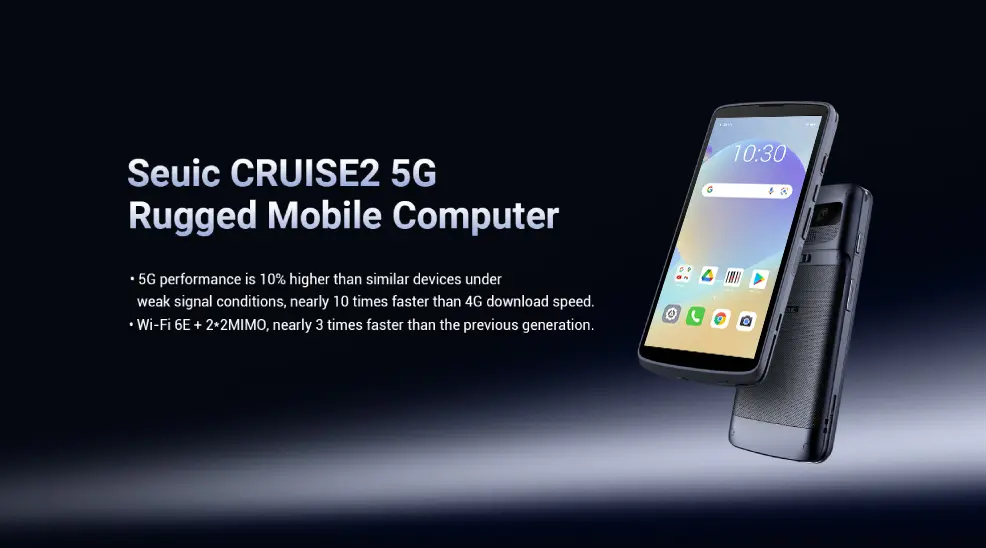
In building a digital quality system, choosing a mobile computer that combines ruggedness, precise data capture, and real-time interaction capabilities is crucial. SEUIC's CRUISE2 5G industrial-grade mobile computer is a benchmark product designed to meet the challenges of manufacturing quality control.
5.1 Excellent Environmental Adaptability Ensures Continuous Operation
CRUISE2 5G achieves an IP68 rating, resistant to oil, dust, and high-pressure water jets. Its military-grade drop resistance ensures stable operation during frequent mobile inspections and sampling.
5.2 5G Network Enables Real-Time Quality Control
Via the low-latency 5G network, inspectors can instantly upload inspection results to the MES system, achieving "traceability upon discovery". For example, in finished product inspection, scanning the serial number retrieves the full production cycle data, increasing customer complaint handling efficiency by over 50%.
5.3 Professional Data Capture Covers Complex Scenarios
The device is equipped with a high-performance scan engine that can accurately read dirty or damaged barcodes. During incoming inspection, employees can simultaneously scan material labels, eliminating manual entry errors.
5.4 Long Battery Life and Ergonomic Design Improve Efficiency
Hot-swappable batteries support continuous operation during shift changes. The high-brightness screen is suitable for bright environments and supports glove touch, meeting the needs of fast production line operations. Combined with the SDK and MDM tools provided by SEUIC, enterprises can quickly customize quality inspection apps and seamlessly integrate them with existing QMS systems, reducing development costs.
Under the trend of smart manufacturing and Industry 4.0, quality control is evolving from "post-event checking" to a full-process digital management of "prevention beforehand, control during the process, and tracing after the event". Choosing a suitable industrial mobile computer is not just purchasing a hardware device; it is introducing a mobile, intelligent, and connected quality control center for your enterprise. It seamlessly connects people, processes, and data, ultimately leading to improved product qualification rates, reduced operational costs, and the defense of brand reputation.
- Demystifying Manual Traceability Pains: How CRUISE2 5G Enables Barcode-Based Bidirectional Traceability2026-04-03
- Demystifying Slow Backroom Transfers: How UTouch 2-S Enables Second-Level Inventory Navigation2026-04-03
- Demystifying Quality Control Bottlenecks: How RFID Moves Towards Proactive Prevention2026-04-02
- How Handheld Computers Achieve End-to-End Traceability2026-04-02
- Demystifying Workstation Information Bottlenecks: How CRUISE2 5G Enables Paperless, Real-Time Operations2026-04-01