Brief Introduction
In today's fast-paced business environment, from production lines to warehouse shelves, from retail checkout counters to outdoor inspection sites, a seemingly simple yet crucial technology is quietly driving efficiency improvements—this is mobile barcode technology. Whether you are a plant manager responsible for optimizing production processes, a warehouse supervisor managing vast inventories, or a pharmacist ensuring medication safety, deeply understanding and effectively applying mobile barcodes has become key to enhancing accuracy, speed, and traceability.
This article will take you through a complete understanding of the world of mobile barcodes, from basic concepts to core technologies, then to practical applications across various industries, and finally provide you with a practical equipment selection guide.
1. Basic Concepts: What Exactly is a Mobile Barcode?
Simply put, a mobile barcode refers to the general term for 1D and 2D barcodes that can be quickly read using handheld mobile devices (such as dedicated scanners, PDAs, etc.). Its core value lies in encoding complex digital and text information into graphics and quickly decoding them through mobile devices, enabling automated information capture and interaction.
Although all are called "barcodes," they have significant differences in form and capability, mainly divided into three categories:
- 1D Barcode (One-Dimensional Barcode): Such as common UPC, EAN-13, Code 128, etc. It stores information by arranging black and white lines of different widths. Its information capacity is small, usually only storing a few dozen characters of letters or numbers, like a product's "ID number."
- 2D Barcode (Two-Dimensional Barcode): Such as QR codes, Data Matrix codes. It stores information through a matrix of black and white dots in both horizontal and vertical directions. It has a huge information capacity, capable of storing thousands of characters, and can contain rich information like website URLs, contact details, image links, etc., like a product's "detailed file."
- DPM Code (Direct Part Marking Code): This is a special type of 2D barcode, directly marked on the surface of product components (like metal, plastic) through methods like laser engraving or chemical etching. It is renowned for its extremely high durability, able to withstand harsh industrial environments like high temperatures, wear, and chemical corrosion, making it an ideal choice for manufacturing traceability and lifecycle management.
2. Technical Analysis: How Does Mobile Barcode Scanning Work?
Mobile barcode scanning technology may seem magical, but its principle can be simplified into three core steps:
- Image Capture: The scanning device (like a scan engine or mobile phone camera) emits light to illuminate the barcode. A sensor then receives the reflected light and generates a digital image of the barcode.
- Decoding Processing: The built-in decoding software in the device pre-processes the image (like positioning, correction, binarization). Then, according to specific algorithm rules (like the positioning pattern of a QR code), it identifies the binary data represented by the black and white modules or lines in the barcode.
- Communication Output: The decoded text information is simulated as keyboard input via an interface (like USB, Bluetooth) and directly sent to the input field of the host system (like ERP, WMS software), completing the entire data capture process.
- Scanning Challenges and Solutions for DPM Codes: Because DPM codes are directly marked on rough or reflective component surfaces, the contrast can be very low, making them difficult for traditional scanners to read. This requires the use of high-resolution imaging scanners, coupled with specialized DPM decoding algorithms and multi-angle lighting systems to ensure a high first-read rate.
3. Industry Application Scenarios: How Do Mobile Barcodes Empower Various Industries?
The application of mobile barcodes has already permeated every corner. Here are some typical scenarios:
- Manufacturing and Factories: Production supervisors and quality inspectors use PDAs to scan barcodes (especially DPM codes) on process cards and products to achieve real-time production progress tracking, quality traceability, and component error-proofing.
- Retail and Inventory Management: Store managers and inventory staff scan product barcodes for quick stocktaking, receiving goods, and price checks. Supermarket operations managers use it to optimize replenishment and inventory turnover.
- Logistics and Supply Chain: Express company operations directors and sorters scan shipping label barcodes to achieve end-to-end package tracking. E-commerce fulfillment centers rely on it for efficient sorting, packing, and shipping.
- Healthcare: Hospital pharmacy departments scan barcodes on drug packaging to ensure dispensing accuracy; nurses scan patient wristbands and medication barcodes to implement the "three checks and seven verifications" protocol, safeguarding patient safety.
- Utilities and Government: Meter readers and field inspectors from water, electricity, and gas companies scan QR codes on equipment to quickly record readings and report faults. Government law enforcement officers scan barcodes on documents or items for information verification.
4. Equipment Selection Guide: How to Choose the Right Mobile Scanning Device for You?
When selecting a mobile scanning device, it is necessary to comprehensively consider factors such as the scanning target, usage environment, battery life and integration needs, and decoding capability. Below, I will analyze each factor in detail with reference to the specific performance of Seuic's AUTOID Q7-(Grip) product to help you make a more informed decision.
4.1 Identify the Scanning Target
- Mainly scanning 1D barcodes? Laser scanners offer good cost-effectiveness and high speed.
- Need to scan 2D barcodes / DPM codes? Must choose an imaging scanner (e.g., one using a CMOS sensor).
- Mostly DPM codes? Be sure to confirm that the equipment manufacturer explicitly supports DPM decoding, and preferably conduct an on-site test.
The AUTOID Q7-(Grip) performs excellently in this aspect: It supports 2D scanning and can handle both 1D and 2D barcodes, including common QR codes and Data Matrix codes. Furthermore, its optional scan engines (standard range, mid-range, and long-range) enable it to adapt to different scanning needs. For example, the long-range scanning capability can reach up to 30 meters, making it ideal for reading barcodes on high shelving in warehouses, while the standard engine is suitable for daily close-range scanning.
4.2 Consider the Usage Environment
- Outdoors or in strong light? Choose devices with high brightness or equipped with a sight.
- Dusty, prone to drops? Pay attention to the device's industrial protection rating (IP rating) and drop resistance height.
- Need mobility? Choose wireless handheld terminals or PDAs with Bluetooth connectivity to free up your hands.
The AUTOID Q7-(Grip) is designed for industrial environments with an IP65 sealing rating, effectively protecting against dust and water, making it suitable for dusty or humid warehouse scenarios. Its drop resistance is excellent, able to withstand a 6.6-foot (2-meter) drop onto a marble surface, ensuring reliability during frequent movement or accidental drops. The product has also passed over 60 reliability tests, including extreme temperatures and high humidity environments, making it suitable for harsh conditions like manufacturing and logistics. Additionally, the straight-shot scanning design and detachable pistol grip enhance operability in bright light or during overhead work. Therefore, if your work environment involves outdoors, high-bay warehouses, or areas prone to impacts, the durability and protective features of the AUTOID Q7-(Grip) can effectively reduce the risk of equipment failure.
4.3 Evaluate Battery Life and Integration Needs
- Long shift operations? Battery life is key; consider having spare batteries.
- Need a screen and keyboard for operation? Choose a fully-featured industrial PDA or handheld terminal.
- Only need scanning function? A simple Bluetooth scanner connected to a phone or tablet might be more economical.
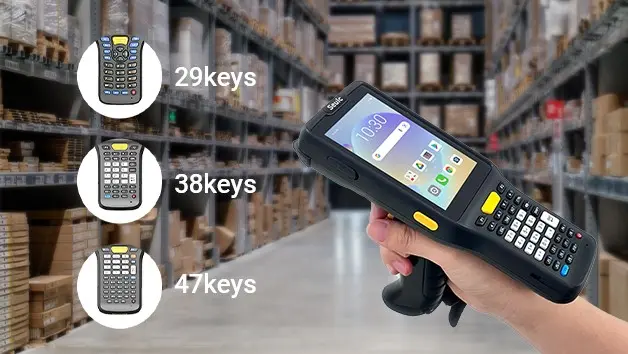
The AUTOID Q7-(Grip) is equipped with a 5200mAh high-capacity battery, supporting long shift operations without frequent charging, making it ideal for continuous scanning tasks in logistics or warehousing. In terms of integration, the product offers three keyboard options (29-key numeric keypad, 38-key hybrid keyboard, and 47-key full-function keyboard), allowing flexible selection based on data input complexity. For example, the 47-key keyboard supports alphanumeric input, reducing the need for switching. Simultaneously, its support for Wi-Fi 6 technology ensures stable data transmission and fast roaming, suitable for warehouse environments with high-density APs, avoiding network interruptions. If you need the device to integrate seamlessly with existing systems (like WMS or ERP), the keyboard customization and wireless connectivity capabilities of the AUTOID Q7-(Grip) can simplify workflows and improve overall efficiency.
4.4 Decoding Capability and Performance
Focus on the first-read rate; this reflects actual work efficiency more than scanning speed. Choose equipment that can quickly and accurately identify damaged, blurry, low-contrast barcodes.
The AUTOID Q7-(Grip) utilizes a self-developed scan engine and a Qualcomm octa-core processor (up to 1.8GHz), enabling it to quickly decode damaged, blurry, or low-contrast barcodes, ensuring a high first-read rate. The product supports a scanning range from close proximity (1.96 inches) to long distance (99 feet) and has been verified for reliability in challenging environments through professional CNAS laboratory testing. Compared to merely pursuing scanning speed, the AUTOID Q7-(Grip) places greater emphasis on stability and accuracy, making it an ideal choice for applications requiring high-precision scanning, such as manufacturing traceability or medical inventory management.
Mobile barcode technology is far more than simple "black and white lines"; it is a bridge connecting the physical world with digital systems, a cornerstone for improving operational efficiency, ensuring data accuracy, and achieving end-to-end traceability. Whether it's the basic 1D barcode, the information-rich 2D barcode, or the rugged DPM code, understanding their principles and differences, and selecting the appropriate scanning solution based on your specific business scenario, will bring tangible value to your enterprise.
- Demystifying Manual Traceability Pains: How CRUISE2 5G Enables Barcode-Based Bidirectional Traceability2026-04-03
- Demystifying Slow Backroom Transfers: How UTouch 2-S Enables Second-Level Inventory Navigation2026-04-03
- Demystifying Quality Control Bottlenecks: How RFID Moves Towards Proactive Prevention2026-04-02
- How Handheld Computers Achieve End-to-End Traceability2026-04-02
- Demystifying Workstation Information Bottlenecks: How CRUISE2 5G Enables Paperless, Real-Time Operations2026-04-01