Brief Introduction
In large-scale intelligent warehousing and logistics centers, fixed RFID readers serve as the core "neurons" of the perception network. Their collaborative efficiency and management level directly determine the effectiveness of intelligent system implementation and operational performance. As warehouse scale expands and operational frequency increases, traditional discrete RFID deployment methods are struggling to adapt to flexible needs. The associated pain points are becoming increasingly prominent, constraining the intelligent upgrade of warehouses. The SEUIC AUTOID UF40 AI Intelligent Fixed RFID Reader was born precisely to address this core demand.
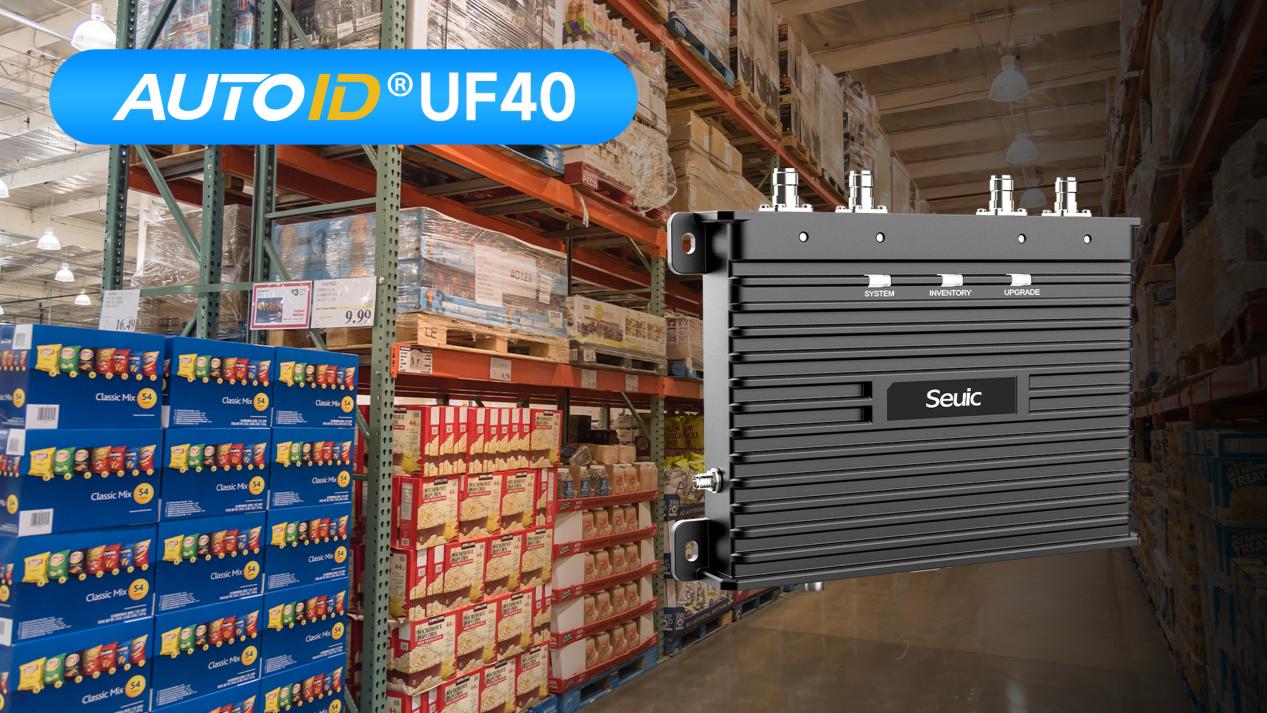
1. In-Depth Analysis of Core Pain Points in Large-Scale Intelligent Warehouse RFID Deployment
The challenges of large-scale RFID deployment run through the entire lifecycle of deployment, integration, and operation & maintenance. The core pain points can be summarized into four points:
Isolated Device Management: In large warehouses, RFID readers scattered across different areas require independent configuration and monitoring. This leads to high management personnel input costs and is prone to management oversights.
Inefficient and Unstable Data Integration: Each reader needs to interface individually with WMS/ERP systems, leading to a surge in interface workload. This not only increases integration difficulty but also easily causes data delays and loss, affecting operational continuity.
Cumbersome Deployment/Debugging and Poor Flexibility: Discrete deployment requires extensive cabling and configuration, prolonging the implementation timeline. During later layout adjustments or device expansion, re-cabling and re-configuration are needed, lacking adaptability.
Difficult Fault Localization and Inefficient Maintenance: With devices scattered, it's hard to quickly locate and troubleshoot faults. Minor issues can easily cause local operational stoppages, affecting the entire warehousing workflow.
2. SEUIC AUTOID UF40 Fixed RFID Reader Solution: Building a Collaborative and Efficient RFID Perception Network
The SEUIC AUTOID UF40 AI Intelligent Fixed RFID Reader is designed with the core philosophy of "Simplifying Complexity, Centralized Intelligent Control." It innovatively adopts a distributed collaborative architecture, integrating physically dispersed readerr devices into a logically unified and managed resource pool. This builds an efficient, stable, and easy-to-maintain RFID neural center, fundamentally solving the numerous drawbacks of traditional deployment models.
2.1 Simplified Interface Integration, Reducing Costs
Using the master-slave station architecture, only one UF40 needs to be designated as the master station, with the remaining devices acting as slave stations. The slave stations automatically report the read tag data to the master station, which processes the data and interfaces with the upper-layer WMS/ERP system through a single network connection. In this model, system integration only requires completing the interface development for the master station once to achieve unified management of all slave station devices. This reduces interface workload, significantly improves integration efficiency, and lowers network bandwidth consumption.
2.2 Flexible Deployment and Maintenance, Adapting to Agile Warehousing
Slave station devices only need power and antenna connections, requiring no complex network configuration. This allows for rapid point deployment, significantly reducing cable procurement and wiring costs, and shortening project implementation timelines. Furthermore, during later warehouse layout adjustments or device expansion, only slave stations need to be added or removed with simple configuration, without modifying the master station's interface logic with the upper-layer systems. This offers strong flexibility and can fully adapt to the agile operational needs of large-scale warehouses.
For large-scale intelligent warehouses, the core value of an RFID system lies not only in the read/write performance of individual devices but more importantly in the manageability, scalability, and operational stability of the entire perception network. The SEUIC AUTOID UF40 AI Intelligent Fixed RFID Reader, with its innovative master-slave intelligent networking technology, precisely targets the core pain points of traditional RFID deployment such as complex device management, high integration costs, and low maintenance efficiency. It successfully upgrades the traditional "device stacking" deployment model to a "collaborative control" neural center model.
The SEUIC AUTOID UF40 AI Intelligent Fixed RFID Reader, by simplifying interface integration, optimizing deployment and maintenance, and achieving visual centralized management, significantly reduces the total lifecycle cost of large-scale warehouse RFID systems. It effectively enhances the collaborative efficiency and stability of warehouse operations. It not only provides solid RFID perception network support for building flexible, efficient, and intelligent logistics systems in large-scale smart warehouses but also offers a practical paradigm for industry-scale RFID deployment.
Founded in 2002, SEUIC Technologies Co., Ltd. has been committed to grasping core technologies, enhancing technological innovation, providing excellent self-owned brand products, including mobile computers, RFID readers, tablets, barcode scanners and fixed readers. With highly reliable products and efficient services, our products have been widely used in manufacturing, retail, logistics & transportation, healthcare and other industries. We provide frontline workers more durable real-time data collection tools, helping you do more thereby to catapult your productivity to the next level.
- Demystifying Manual Traceability Pains: How CRUISE2 5G Enables Barcode-Based Bidirectional Traceability2026-04-03
- Demystifying Slow Backroom Transfers: How UTouch 2-S Enables Second-Level Inventory Navigation2026-04-03
- Demystifying Quality Control Bottlenecks: How RFID Moves Towards Proactive Prevention2026-04-02
- How Handheld Computers Achieve End-to-End Traceability2026-04-02
- Demystifying Workstation Information Bottlenecks: How CRUISE2 5G Enables Paperless, Real-Time Operations2026-04-01