Brief Introduction
In the electronics manufacturing industry, especially in the production process of Printed Circuit Boards (PCBs), achieving full lifecycle traceability from raw materials to finished products, and even to end products, is not only key to improving quality control but also a cornerstone for meeting mandatory requirements in high-reliability fields such as automotive electronics, medical devices, and aerospace. However, reading the source of traceability—the DPM (Direct Part Mark) codes directly marked on PCB boards—has become a recognized technical challenge on automated production lines due to their unique marking methods and harsh industrial environments. The SEUIC X4 AI Industrial Code Reader, with its native AI vision capability, provides the PCB industry with a stable, efficient, and calibration-free ultimate solution for reading DPM codes.
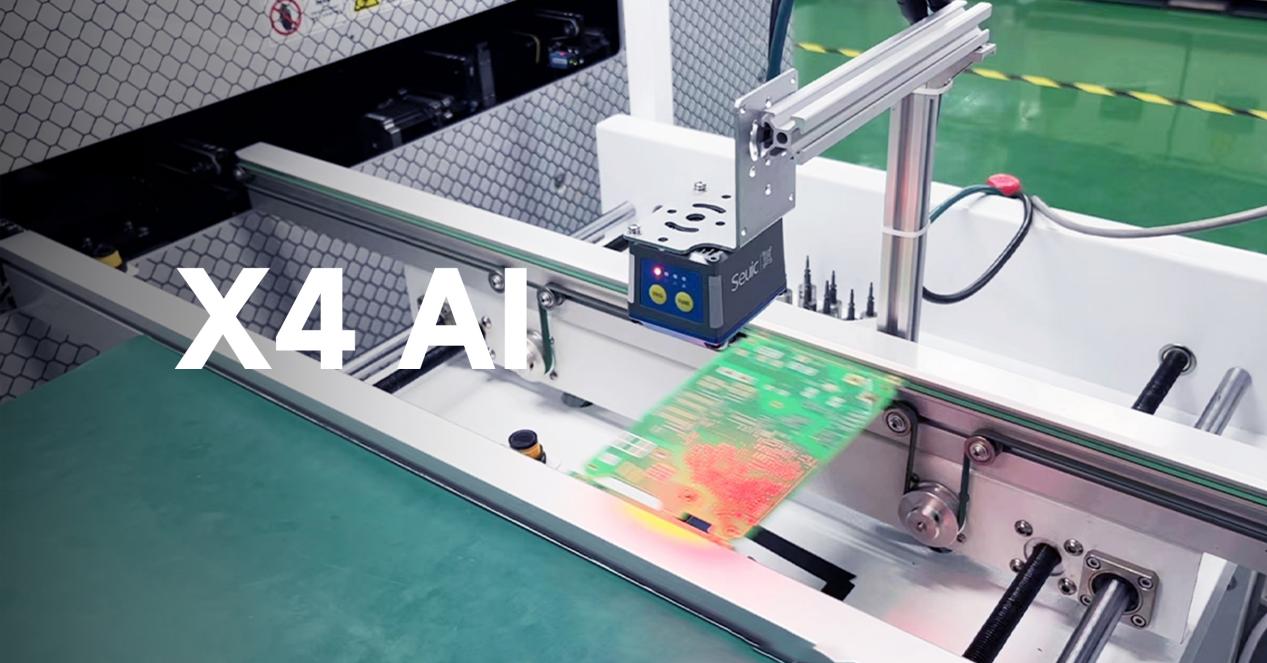
1. Reading DPM Codes on PCB Boards: Why Do Traditional Vision Solutions Often Fail?
DPM codes on PCB boards are typically applied by laser engraving or inkjet printing, directly attached to the substrate, solder mask, or metal base. This application scenario creates multiple highly challenging reading obstacles:
Extreme Contrast Issues: The most common are "positive/negative codes" - dark codes (positive) engraved on light-colored solder masks (e.g., white, yellow), or light codes (negative) engraved on dark-colored solder masks (e.g., black, blue). The contrast between the code and the background can vary dramatically, which fixed-threshold traditional algorithms cannot handle simultaneously.
Complex Background Interference: PCB surfaces are covered with dense copper traces, silkscreen characters, pads, and holes. DPM codes often have to "squeeze" into limited blank areas, intertwined with these complex background patterns, making them highly susceptible to misreads or interference.
High Reflectivity and Material Diversity: Smooth solder mask ink, exposed metal pads or gold fingers, and inks of different colors can all cause specular or diffuse reflection, creating interfering glare. Codes might be marked on flat FR-4 substrates, or on curved components or uneven heat sinks.
Tiny Size and High Density: Limited by PCB space, DPM codes (especially DataMatrix codes) are usually very small (e.g., 2x2mm) with dense dot matrices, placing extreme demands on the optical resolution and decoding accuracy of the code reader.
These factors cause traditional code readers to perform extremely unstably in this scenario: low first-read rate, high misread rate, and the need for tedious light source and parameter adjustments for each batch or even each model of PCB, severely constraining production cycle time and flexible manufacturing capabilities.
2. SEUIC X4 AI's Solution: Redefining DPM Code Reading Logic with AI
The design philosophy of the SEUIC X4 AI Industrial Code Reader is to enable the machine to "understand" images like the human eye combined with the brain, rather than just "scanning" them. It systematically overcomes the above challenges through the integration of the following core technologies:
2.1 AI-Driven Intelligent Image Preprocessing and Feature Enhancement
Facing positive/negative codes and complex backgrounds, the X4 AI's deep learning algorithm plays a decisive role:
Adaptive Image Segmentation: The AI model can intelligently distinguish between the "code that needs to be read" and the "background that needs to be ignored." Whether the background is cluttered traces or silkscreen characters, the algorithm can precisely separate interference and lock onto the genuine DPM code region.
Dynamic Contrast Normalization: For positive/negative codes with drastically varying contrast, the AI can dynamically adjust the image processing strategy, automatically enhancing the effective features of both positive and negative codes, ensuring a high read rate for both without needing to set different parameters for different board types.
2.2 Targeted Hardware Optical Design
Semi-Polarized Optical System: This is a powerful tool for dealing with various reflections on PCB boards. Through polarization technology, it can effectively suppress specular highlights from smooth inks and metal surfaces, directly obtaining a clear underlying image "with reflections removed," providing high-quality input for the AI algorithm.
High-Resolution Sensor and Precision Light Source: A 1.3-megapixel global shutter sensor combined with multi-angle adjustable LED lights can clearly capture micron-level code dot details and provides multiple lighting schemes to adapt to different materials and deep recess marking scenarios.
2.3 Revolutionary 'Plug-and-Play' and Zero-Calibration Deployment
In traditional solutions, engineers spend hours on the cycle of "lighting test - parameter adjustment - verification and optimization." The SEUIC X4 AI completely revolutionizes this process:
Power-On Self-Adaptation: After installation, simply power on the device. Its built-in AI algorithm automatically analyzes typical PCB board images within the field of view and completes the optimization calculation and setting of all core parameters (focus, exposure, gain, light source intensity, etc.) autonomously within seconds.
One-Click Switching and Learning: When the production line switches to different models or colors of PCB boards, there is no need for reprogramming or manual debugging. The operator only needs to let the device scan a few new samples, and the AI model can quickly learn and adapt to the new working condition, truly supporting mixed-line production and quick changeovers.
3. Empowering PCB Smart Manufacturing: Moving from Accurate Traceability to Data-Driven
Integrating the SEUIC X4 AI Industrial Code Reader into key nodes of PCB production (e.g., after etching, after solder mask application, before final testing) brings value far beyond simple "code reading":
Closed-Loop Full-Process Quality Traceability: Provides each PCB with a unique and reliably readable "ID card," achieving full-link data binding from raw material batches and production process parameters to test results. Once a quality issue occurs, it can be instantly and accurately traced back to the specific production line, shift, or even a single board.
Improve Overall Equipment Effectiveness (OEE): A near-100% stable read rate eliminates production line stoppages, manual intervention, or product reflow caused by read failures. Seamless integration with MES/ERP systems enables automatic reporting of production progress.
Support Flexible and Intelligent Production: Its powerful self-adaptive capability enables small-batch, multi-variety production modes and can automatically verify whether the product model matches the production order, preventing material mixing.
Reduce Comprehensive Costs: Significantly reduces reliance on specialized vision engineers for debugging and maintenance, lowering labor costs and technical barriers, while also delivering considerable long-term return on investment through improved yield and efficiency.
On the path of electronics manufacturing towards greater precision, reliability, and intelligence, reliable data collection is an unshakable cornerstone. The challenge of reading DPM codes on PCB boards was once a technical chasm between ideal and reality. The SEUIC X4 AI Industrial Code Reader, with its integrated hardware-software AI vision solution, not only smoothly bridges this chasm but also transforms the code reading step from a "production bottleneck" into a "data advantage."
Founded in 2002, SEUIC Technologies Co., Ltd. has been committed to grasping core technologies, enhancing technological innovation, providing excellent self-owned brand products, including mobile computers, RFID readers, tablets, barcode scanners and fixed readers. With highly reliable products and efficient services, our products have been widely used in manufacturing, retail, logistics & transportation, healthcare and other industries. We provide frontline workers more durable real-time data collection tools, helping you do more thereby to catapult your productivity to the next level.
- Demystifying Manual Traceability Pains: How CRUISE2 5G Enables Barcode-Based Bidirectional Traceability2026-04-03
- Demystifying Slow Backroom Transfers: How UTouch 2-S Enables Second-Level Inventory Navigation2026-04-03
- Demystifying Quality Control Bottlenecks: How RFID Moves Towards Proactive Prevention2026-04-02
- How Handheld Computers Achieve End-to-End Traceability2026-04-02
- Demystifying Workstation Information Bottlenecks: How CRUISE2 5G Enables Paperless, Real-Time Operations2026-04-01