Brief Introduction
In today's fast-paced logistics, retail, and healthcare industries, efficient data management is core to operations. Whether you are a plant manager optimizing production lines or a pharmacy employee tracking drug inventory, barcode technology plays a key role. But have you ever wondered why some barcodes are simple lines while others are complex square patterns? This is the difference between 1D and 2D barcodes. Choosing the wrong barcode type or scanner can lead to inefficiencies, increased error rates, and even higher costs. This article delves into the definition of a 2D barcode, clearly compares the key differences between 1D and 2D barcodes, and provides a practical guide to help you make an informed choice between a 1D barcode reader or a 2D barcode reader. Whether your background is in warehouse management or field inspection, this article will provide you with actionable knowledge.
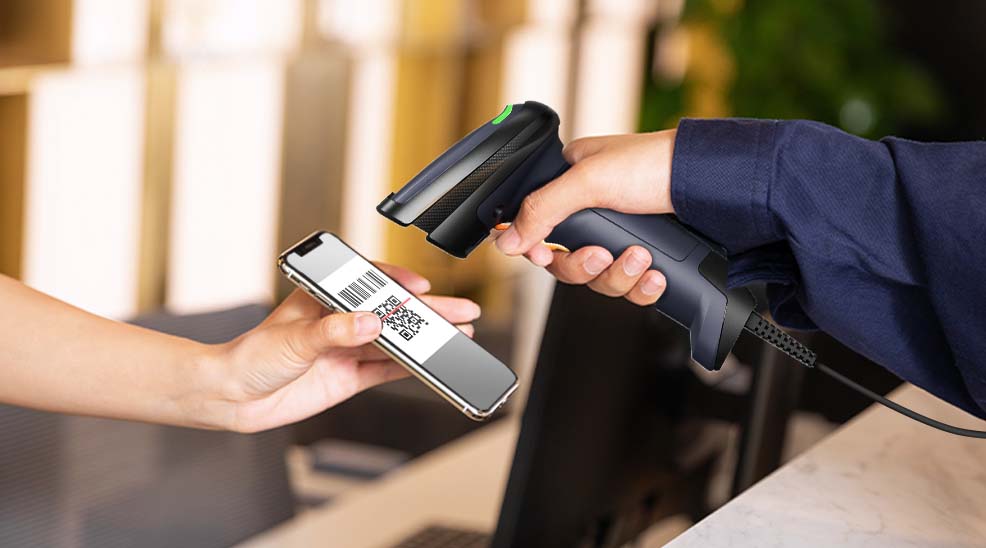
1. What is a 2D Barcode? The Evolution Beyond Traditional Barcodes
A 2D barcode (two-dimensional barcode) is a matrix-style code capable of storing information both horizontally and vertically, in sharp contrast to traditional 1D barcodes (one-dimensional barcodes) which can only encode horizontally. Common types of 2D barcodes include QR Code (Quick Response Code), Data Matrix, and PDF417. They encode data using patterns, dots, or squares, rather than simple lines. This design allows 2D barcodes to store significantly more information - for example, a single QR code can hold thousands of characters, including text, URLs, and even binary data (like images). In comparison, a 1D barcode typically stores only 20-25 characters, such as a UPC code used for retail products.
The advantages of 2D barcodes lie in their high density and data redundancy. They have built-in error correction capabilities, allowing them to be read even if partially damaged. This is particularly useful in harsh environments like warehouses or outdoors. The adoption rate of 2D barcodes is increasing annually in healthcare and logistics sectors because they support traceability and automation.
Why are 2D Barcodes Becoming Increasingly Popular?
- High Data Capacity: Suitable for storing serial numbers, batch numbers, or complete product information.
- Space Efficiency: Small size allows printing on electronic products or small packages.
- Error Recovery: Redundant design reduces scan failure risk, improving 2D barcode reader reliability.
For target audiences like quality control personnel or pharmacists, 2D barcodes can simplify compliance records; for e-commerce logistics employees, they speed up order processing. Next, we will compare 1D and 2D barcodes to help you understand when to upgrade your technology.
2. 1D vs 2D Barcodes: Key Differences and Applicable Scenario Analysis
When choosing a barcode system, understanding the differences between 1D and 2D barcodes can avoid wasted resources. The following provides a detailed comparison from the perspectives of data capacity, readability, and application, using tables and bullet points for readability.
2.1 Data Capacity and Encoding Methods
- 1D Barcode (One-dimensional): Consists of parallel lines, encodes data only horizontally. For example, the EAN-13 code in retail stores product IDs. Limited data capacity (usually <100 characters), suitable for simple identification.
- 2D Barcode (Two-dimensional): Uses matrix patterns, encodes both vertically and horizontally. A single Data Matrix code can store up to 2,335 alphanumeric characters, suitable for complex data like URLs or instruction manuals.
Key Differences Summary Table:
| Comparison Item | 1D Barcode | 2D Barcode |
| Data Capacity | Low (20-100 characters) | High (up to thousands of characters) |
| Error Correction | None or basic; difficult to read if damaged | Advanced correction; readable even if partially damaged |
| Space Required | Relatively large, requires certain length | Compact, suitable for small items |
| Common Applications | Retail checkout, inventory labels | Medical tracking, asset management, marketing |
| Scanner Requirements | Typically requires a 1D barcode reader (laser type) | Requires a 2D barcode reader (imager type) |
- Scenarios suitable for 1D barcodes: Supermarket checkout (fast price scanning), basic warehouse inventory management. For example, an operations manager in a high-speed environment might prioritize a 1D system for cost-effectiveness.
- Scenarios suitable for 2D barcodes: Hospital drug tracking (storing batch numbers and expiration dates), logistics parcel routing (encoding complete delivery information). For field inspectors like utility company employees, 2D codes can embed meter data, improving accuracy.
Why does the choice matter? An wrong choice can create bottlenecks: for example, using a 1D barcode for complex data forces additional manual entry, while using a 2D system for simple tasks is an over-investment. Understanding these differences is the first step to optimizing your workflow.
3. How to Choose the Right Scanner for 1D and 2D Barcodes
Choosing a scanner is a critical step in implementing a barcode system. An inappropriate 1D barcode reader or 2D barcode reader can lead to compatibility issues or inefficiencies. This section provides a selection guide based on industry practices, focusing on technology type, environmental factors, and cost.
3.1 Scanner Type Overview
- Laser Scanner: The traditional choice, reads 1D barcodes via a laser beam. Advantages include high speed and durability, but cannot read 2D barcodes. Suitable for pure 1D environments like retail or warehousing, but has limited upgrade potential.
- Imager Scanner: Uses a camera to capture codes, can read both 1D and 2D barcodes. This is the standard for 2D barcode readers, offering high flexibility and support for codes like QR codes. Ideal for mixed environments like healthcare or logistics.
- Smartphone Scanner: Achieved through apps, low cost but less reliable, only suitable for temporary uses like marketing.
3.2 Selection Factors Checklist
Consider the following points to ensure the scanner matches your needs:
- Barcode Type: If your business involves 2D barcodes (e.g., for traceability), you must choose an imager scanner. Pure 1D environments might consider laser scanners to save costs.
- Scanning Distance and Environment: Warehouse employees need durable, long-range scanners; pharmacists might prioritize close-range accuracy.
- Integration Compatibility: Ensure the scanner is compatible with existing software (e.g., ERP system). Consult suppliers to test samples.
- Total Cost of Ownership: Imager scanners have a higher initial cost but save labor in the long run; evaluate ROI, especially for logistics center managers.
Example: A apparel brand warehouse reduced mis-scan rates by 30% after upgrading to 2D barcodes and using a universal 2D barcode reader. Conversely, a supermarket chain insisted on Professional Advice: If you operate in a mixed environment (e.g., both 1D product codes and 2D serial numbers), investing in a hybrid scanner is wise. Regularly train employees, such as distribution personnel, to ensure correct usage.
Understanding what a 2D barcode is and its differences from a 1D barcode is the foundation for optimizing data management. 2D barcodes offer high capacity and resilience, while 1D barcodes still hold value in simple scenarios. When choosing a scanner, evaluate business needs - if you handle complex data or pursue future development, a 2D barcode reader is the better choice; otherwise, a 1D barcode reader may suffice. As a professional, from plant supervisors to government inspectors, correct implementation can improve accuracy and save time.
- Demystifying Manual Traceability Pains: How CRUISE2 5G Enables Barcode-Based Bidirectional Traceability2026-04-03
- Demystifying Slow Backroom Transfers: How UTouch 2-S Enables Second-Level Inventory Navigation2026-04-03
- Demystifying Quality Control Bottlenecks: How RFID Moves Towards Proactive Prevention2026-04-02
- How Handheld Computers Achieve End-to-End Traceability2026-04-02
- Demystifying Workstation Information Bottlenecks: How CRUISE2 5G Enables Paperless, Real-Time Operations2026-04-01