Brief Introduction
Against the backdrop of continuous growth in demand for the optical fiber and cable industry and accelerated digital transformation, 5G collaboration platforms have become important tools for enterprises to improve production efficiency and optimize management processes. However, when implementing 5G collaboration platforms, many manufacturing companies often fall into the misconception of "overemphasizing software while neglecting hardware"—focusing excessively on platform functional modules and interface design while overlooking terminal equipment compatibility and performance. Handheld computer devices like the SEUIC CRUISE2 5G, tailored to industry scenarios, are becoming key to solving this dilemma. As the IT director of an optical fiber and cable company stated: "Even if the 5G collaboration platform has perfect functionality, if the terminal equipment cannot stably support it, the platform's value cannot be truly realized, and may even hinder the overall informatization process. The SEUIC CRUISE2 5G shows us how terminal equipment can support platform implementation."
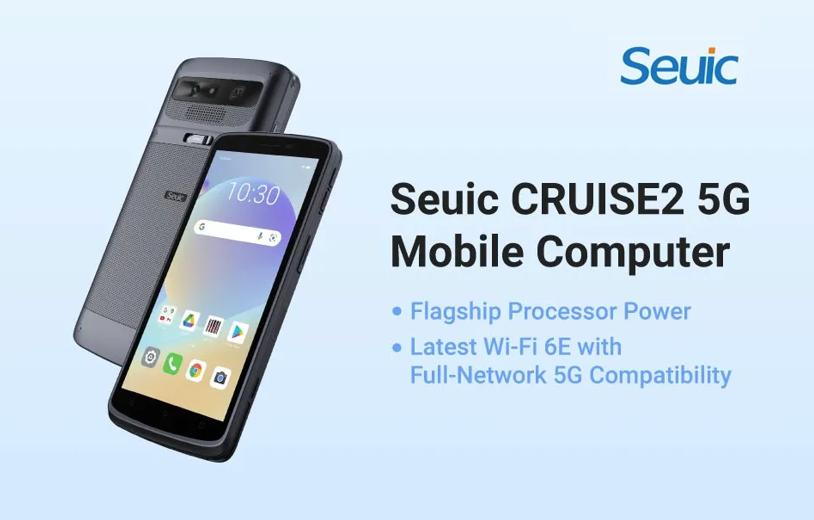
This optical fiber and cable company initially used terminal equipment with Windows CE systems. As the 5G collaboration platform upgraded, these devices gradually revealed significant shortcomings. On one hand, the software ecosystem for Windows CE had stagnated, making it incompatible with core modules in the new platform such as real-time production data synchronization and mobile inspection reporting. On the other hand, the outdated hardware configuration led to slow operation response and frequent lag when handling multiple tasks, severely affecting frontline workshop employees' work efficiency. After comparing multiple terminal devices, the company ultimately chose the SEUIC CRUISE2 5G. The reason this device gained recognition lies in its precise solution to four core pain points faced by optical fiber and cable companies in implementing 5G collaboration platforms.
Pain Point 1: Insufficient Hardware Performance, Platform Operation Lag
5G collaboration platforms need to simultaneously handle multiple tasks such as production data transmission, inspection task dispatch, and material information queries, placing high demands on terminal equipment computing power. The SEUIC CRUISE2 5G is equipped with a high-performance Qualcomm QCM4490 processor, combined with a new-generation AI computing platform and Android 13 operating system, enabling smooth operation of multi-tasking high-load applications. Its multi-core architecture ensures low-latency response even when the 5G collaboration platform simultaneously handles production data synchronization, inspection dispatch, and information queries, completely avoiding operation lag issues and significantly improving frontline operational continuity.
Pain Point 2: Low Scanning Efficiency, High Error Rates, Affecting Material and Inspection Management
In optical fiber and cable production processes, material labels often have issues such as high-density printing, wear from long-term storage, and reflection under strong workshop lighting, making them difficult for traditional scanning equipment to quickly identify. This not only slows down material verification but also leads to material mismatches due to identification errors. The SEUIC CRUISE2 5G utilizes an AI-enhanced intelligent recognition engine, supporting identification of high-density barcodes as small as 3Mil, with strong fault tolerance for worn, reflective, or stained barcodes. The scanning speed increases to 1.5m/s motion tolerance, and combined with OCR technology, achieves multiplied recognition efficiency in complex scenarios. Data is directly transmitted to the platform after scanning, eliminating manual entry errors, providing a high-precision real-time data entry point for material management and inspections.
Pain Point 3: Poor Signal Coverage, Insufficient Connection Stability
Production scenarios in optical fiber and cable companies are particularly challenging—underground raw material warehouses, long production tunnels, and large workshops often have signal obstruction, attenuation, or interference issues, causing data transmission interruptions or delays between terminal equipment and the platform. The SEUIC CRUISE2 5G utilizes 5G multi-band carrier aggregation and Wi-Fi 6E dual-channel MIMO technology, achieving 10% better performance than similar devices in weak signal environments, with download speeds nearly 10 times faster than 4G. It supports simultaneous tri-band operation (2.4GHz/5GHz/6GHz), effectively avoiding signal interference in complex environments like workshops and warehouses, ensuring real-time data transmission and second-level command delivery in underground tunnels or large factory buildings.
Pain Point 4: Short Battery Life, Inability to Hot-Swap, Interrupting Continuous Operations
Optical fiber and cable companies mostly adopt continuous operation modes. Frontline employees use terminal equipment for 8-10 hours daily for tasks like inspections and material verification. If equipment battery life is insufficient or requires shutdown for battery replacement, workflow interruptions are likely. The SEUIC CRUISE2 5G is equipped with a 5000mAh large-capacity battery, combined with AI dynamic power management, supporting continuous operation for over 12 hours. Its innovative hot-swappable battery design allows battery replacement without shutdown, perfectly adapting to continuous production modes, ensuring zero interruption to 5G collaboration platform tasks, and significantly reducing operational stagnation risks due to power issues.
The implementation effectiveness of 5G collaboration platforms depends not only on the platform's functional design but also closely relates to the performance and scenario adaptability of terminal equipment. The SEUIC CRUISE2 5G provides targeted solutions from four core dimensions—performance, scanning, signal, and battery life—based on the actual operational needs of optical fiber and cable companies. It ensures stable performance of 5G collaboration platform functions while providing hardware support for enterprises to reduce digital implementation barriers and improve operational efficiency. For optical fiber and cable companies advancing 5G collaboration platform construction, such industry-scenario-tailored terminal equipment is undoubtedly a practical choice in the digital transformation process.
For years, SEUIC has focused on the research and development of products such as RFID readers, fixed scanners, handheld PDAs, and industrial barcode scanners. Leveraging extensive design experience in the industrial 4G/5G terminal field and relying on highly reliable product capabilities and efficient services, our products have been widely used in manufacturing, retail e-commerce, logistics and express delivery, healthcare, and public utilities.
- Demystifying Manual Traceability Pains: How CRUISE2 5G Enables Barcode-Based Bidirectional Traceability2026-04-03
- Demystifying Slow Backroom Transfers: How UTouch 2-S Enables Second-Level Inventory Navigation2026-04-03
- Demystifying Quality Control Bottlenecks: How RFID Moves Towards Proactive Prevention2026-04-02
- How Handheld Computers Achieve End-to-End Traceability2026-04-02
- Demystifying Workstation Information Bottlenecks: How CRUISE2 5G Enables Paperless, Real-Time Operations2026-04-01