Brief Introduction
As a plant manager, warehouse supervisor, or retail operations leader, are you troubled by the following issues?
Monthly/quarterly inventory counting is time-consuming and labor-intensive, with data accuracy difficult to guarantee?
Finding specific goods or assets in a vast warehouse is like finding a needle in a haystack?
High rates of shoplifting and misplacement in stores make accurate inventory visualization difficult?
Periodic inspections of outdoor or scattered assets (e.g., gas cylinders, power equipment, medical devices) are inefficient and error-prone?
If the answer is yes, then long-range RFID (Radio Frequency Identification) reader technology is the solution you are looking for. It transcends the limitations of traditional barcode "one-item, one-scan" methods, achieving batch, remote, non-line-of-sight automatic identification and data collection, elevating operational efficiency to new heights. This article will clearly explain the core of this technology to help you make informed technology selection decisions.
1. Core Principle of Long-Range RFID Technology: How Does It "Retrieve Objects Remotely"?
To understand long-range RFID, one must first distinguish RFID frequency bands. Common Low-Frequency (LF) and High-Frequency (HF) RFID (e.g., access cards, payment cards) typically have a recognition range in the centimeter level. The long-range RFID we refer to specifically denotes the Ultra-High Frequency (UHF) band, which usually operates between 860-960 MHz.
Its core principle is backscatter modulation:
Reader Transmits Radio Waves: The reader, via its antenna, continuously emits electromagnetic energy at a specific frequency into the surrounding space.
Tag Harvests Energy and Responds: When a passive UHF RFID tag enters the reader's electromagnetic field, its built-in antenna captures some of the energy, activating the tag chip.
Tag Backscatters Signal: The tag chip modulates its stored ID information (e.g., EPC code) onto the reflected signal and sends it back to the reader.
Reader Receives and Decodes: The reader antenna receives the weak signal reflected from the tag, amplifies and decodes it, and finally transmits the tag information to the backend system.
It is this characteristic that enables UHF RFID to achieve rapid identification over distances ranging from several meters to tens of meters, especially when using high-gain antennas and high-power readers.
2. Long-Range Reading: What Factors Affect Your "Range"?
In practical applications, the read distance is not a fixed value; it is influenced by multiple factors:
Reader Power and Sensitivity: Higher output power (usually expressed in dBm) means stronger transmitted energy, allowing tags to be awakened from farther away; higher receiver sensitivity allows the reader to detect fainter return signals from tags, extending the effective range.
Antenna Performance: Antenna gain (dBi) and polarization (linear/circular) are key. High-gain antennas concentrate energy like a spotlight, increasing directional read range; circularly polarized antennas are less sensitive to tag orientation, making them more suitable for scenarios where tag orientation is random.
Tag Performance: The tag's chip sensitivity and antenna design determine the energy threshold required for activation and its reflection efficiency. Specialized tags are needed for materials like metal or liquids.
Environmental Interference: Metal surfaces cause strong reflections leading to multipath interference; large amounts of water or dense goods can absorb RF energy. These can significantly reduce the effective read range or cause missed reads.
Reader Protocol and Speed: The stable read distance for rapid inventory in dense mode might differ from that for single-tag reading. A balance between speed and range must be found based on the scenario.
3. Core Application Scenario Analysis: Who Needs Long-Range RFID the Most?
3.1 Smart Warehousing and Logistics (Warehouse RFID)
Batch In/Outbound: Forklifts or AGVs carrying readers pass through warehouse doors, instantly completing automatic verification of full pallets or cases.
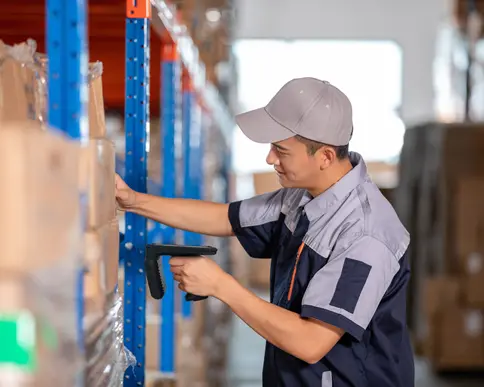
Dynamic Inventory: Workers walking aisles with handheld mobile readers can quickly inventory hundreds of items on shelves without scanning each one individually.
In-Transit Visibility: Fixed readers installed on sorting lines or conveyors track package flow in real-time.
3.2 Retail and Store Management
Smart Fitting Room/Inventory Cart: Quickly identify multiple garments taken into a fitting room, or for rapid post-business inventory.
Loss Prevention and Anti-Theft: Readers deployed at exits trigger real-time alarms for tagged items that haven't been deactivated.
Inventory Visibility: The backend system knows the on-shelf/in-stock status of each item in real-time, enabling precise replenishment.
3.3 Asset and Equipment Management (Hospitals, Enterprises, Utilities)
Medical Equipment Tracking: Quickly locate expensive mobile medical equipment within a hospital, improving utilization and ensuring timely maintenance.
Gas Cylinder/Tool Management: Readers at filling stations or tool room entrances automatically record movement information.
Smart Inspection (Power, Gas, Water): Inspectors can read data from meters, valves, and other outdoor assets from several meters away using handheld devices, safely and efficiently.
3.4 Smart Transportation and Law Enforcement
Vehicle Management: Enable non-stop automatic identification at parking lots, campus entrances/exits.
File/Certificate Management: Quickly locate and find densely stored files or certificates in bulk.
4. Key Technical Parameter Interpretation: Understanding the Product Spec Sheet
When selecting a product, understanding the technical parameters is crucial:
Read/Write Distance: Distinguish between the maximum identification distance (ideal open environment) and the stable identification distance (typical application environment). The latter is more representative.
Antenna Gain and Polarization: Choose based on the scenario. High-gain directional antennas suit choke points like passages/doors; medium-gain omnidirectional or circularly polarized antennas suit mobile inventory.
Output Power: Typically adjustable within a range like 0-33 dBm (~2W). Adjustable power allows flexible performance optimization based on the environment and regulations.
Supported Protocols: Must comply with mainstream standards like EPCglobal UHF Class 1 Gen 2 (ISO 18000-6C), the universal language for global UHF RFID.
Anti-Collision Algorithm: The number of tags readable per second (e.g., >900 tags/sec) determines the inventory speed in dense tag environments.
Interfaces and Protection Rating: Rich interfaces (e.g., RS232, RJ45, WiFi, Bluetooth) facilitate integration; a high IP rating (e.g., IP65) ensures stable operation in dusty, damp, or outdoor environments.
Operating Temperature Range: Industrial-grade devices typically require a wide range (e.g., -20°C to 70°C) to adapt to harsh conditions.
5. Focusing on a Professional Brand: SEUIC AUTOID UTouch 2 - A Benchmark in Long-Range RFID Handheld Devices
Among the many RFID device options, choosing one that truly meets the demands of high-intensity, stringent industrial scenarios is crucial. SEUIC, a leading global provider of automatic identification equipment, has launched the AUTOID UTouch 2 UHF RFID Handheld Reader/Writer. It combines top-tier performance with industrial-grade ruggedness, setting a new benchmark for scenarios like warehousing and logistics, asset inspection, and retail inventory. Below, we analyze its core advantages based on its official specifications.
5.1 Ultimate RFID Reading Performance: A Breakthrough in Speed and Distance
The core competitiveness of the AUTOID UTouch 2 lies in its exceptional RFID capture capability.
Ultra-High-Speed Reading: Equipped with a new-generation RFID engine and unique anti-collision algorithm, it achieves a group read speed of up to 1,300 tags per second. This means the device can instantly perform batch identification during the inbound/outbound or inventory of hundreds or thousands of items, drastically compressing the lengthy process associated with manual scanning or ordinary readers, thereby greatly improving operational efficiency.
Ultra-Long-Distance Identification: Its effective identification distance can reach up to 20 meters. This allows workers to easily inventory items on high shelves or at a distance from the aisle without close contact, making it especially suitable for high-bay warehouses, large outdoor areas, etc.
Multi-Scenario Adaptiveness: The device supports one-key switching between different identification modes (e.g., long-range read, dense tag read, precise item finding mode) and can read various special tags like temperature-sensing and LED tags, easily handling needs from daily rapid inventory to complex material management.
5.2 Rugged Design and Reliability Born for Industrial Environments
Industrial environments place harsh demands on device durability. The AUTOID UTouch 2 is exemplary in this regard:
Excellent Drop, Dust, and Water Resistance: The device has an IP67 protection rating, making it completely dust-tight and able to withstand temporary immersion. Furthermore, its rugged body has passed strict tests for multiple drops from 1.2 meters onto concrete, enabling it to withstand inevitable bumps and drops in scenarios like warehouses and logistics transport, ensuring long-term stable operation and reducing downtime risk due to equipment failure.
Wide-Temperature Operation Capability: Its operating temperature range is -20°C to 50°C, maintaining stable performance whether in cold chain warehouses or hot outdoor summer environments, offering strong adaptability.
5.3 Battery Life and Connectivity Ensuring Continuous Operation
Revolutionary Dual-Battery System: The device features a dual-battery design with a 5000mAh main body battery and a 6700mAh hot-swappable handle battery, totaling a high capacity of 11700mAh. This design not only provides ultra-long continuous operation but, crucially, supports hot-swapping – the handle battery can be replaced quickly during work breaks without shutting down the device, truly achieving "24/7 uninterrupted" continuous operation, perfectly matching multi-shift operational needs.
High-Speed Stable Data Transmission: Integrated with Wi-Fi 6 technology, it offers a 39% increase in transmission speed and a 2-3 times increase in network capacity compared to the previous generation standard. This means the device can achieve faster and more stable data upload/download in complex warehouse network environments, avoiding data delays or loss, and ensuring the real-time nature of inventory information.
6. SEUIC Case Study: Application of UHF RFID in J&T Express's Reusable Bag Inventory Management at a Logistics Center
As one of the world's largest express delivery companies, J&T Express operates in 13 countries. Its vast logistics network places extremely high demands on operational efficiency. The company successfully applied UHF RFID technology in its reusable bag inventory management at logistics centers, providing a highly valuable reference model for warehouse management of similar scale.
Challenges
- Inefficient Batch Scanning: Each transfer center needed to handle the inventory of 5,000 to 8,000 reusable bags daily. Relying on traditional barcode technology required "one-to-one" scanning, resulting in massive workload, cumbersome operations, and easy causing congestion during peak hours.
- Difficulty Ensuring Inventory Accuracy: The manual scanning method had a high error rate, leading to frequent discrepancies between records and physical stock, difficulty tracing the causes of differences, directly impacting operational efficiency and customer satisfaction. Labor Costs and Resource Waste: Employees spent significant time on repetitive, low-value scanning and searching tasks. Labor costs continued to rise while productivity gains were limited.
Solutions
- Deploy Advanced UHF RFID Reading Equipment: Adopted the SEUIC AUTOID UTouch 2 handheld UHF RFID reader, utilizing its rapid batch reading capability to completely overturned the traditional "one-item, one-scan" model.
- Implement an Integrated Reusable Bag Inventory Management Solution: Implanted RFID tags into the reusable bags, enabling rapid identification and management throughout the entire process – bundling, inbound, inventory counting, and outbound – using handheld RFID scanners.
- Build a Complete Parcel Tracking System: Deeply integrated the RFID system with the backend management system, achieving real-time visible management of reusable bags from inbound to outbound, with automatic data updates, providing immediate and accurate data support for decision-making.
Achievements
- Efficiency Increased by an Order of Magnitude: Achieved an operational speed of accurately scanning 2,000 reusable bags within 2 minutes, representing a tremendous leap in inventory counting efficiency compared to traditional methods.
- Achieved Near-Perfect Inventory Accuracy: Inventory counting accuracy reached 99%, fundamentally resolving the persistent issue of book-to-physical discrepancies and realizing precise inventory data management.
- Profound Transformation of Operational Model: Significantly reduced manual operation time and error rates, lowered operational costs, and liberated employees from repetitive tasks, allowing them to shift to higher-value work, successfully completing the digital transformation of this operational stage.
In summary, the SEUIC AUTOID UTouch 2 is not merely a simple collection of specifications, but a comprehensive solution crafted from a deep understanding of industrial users' pain points. It excels in four key dimensions: read performance, ruggedness, battery life & connectivity, and practical validation, providing a reliable and efficient choice for enterprises investing in long-range RFID technology. If you are seeking a solution to enhance inventory counting efficiency or asset tracking accuracy, the AUTOID UTouch 2 is undoubtedly a highly recommended option worth serious evaluation.
Long-range RFID readers are no longer distant cutting-edge technology but mature tools for various industries to achieve digital transformation and move towards refined operations. From second-level inventory counting in warehouses to real-time retail inventory management, and from end-to-end asset tracking to efficient outdoor inspections, their value is being widely validated. Successful application begins with correct understanding and selection. It is hoped that this systematic overview—from principles to parameters, and from scenarios to selection criteria—can help clear any confusion and assist you in finding the long-range RFID solution that best addresses your specific business pain points. Investing in the right technology is an investment in future efficiency and competitiveness.
- Demystifying Manual Traceability Pains: How CRUISE2 5G Enables Barcode-Based Bidirectional Traceability2026-04-03
- Demystifying Slow Backroom Transfers: How UTouch 2-S Enables Second-Level Inventory Navigation2026-04-03
- Demystifying Quality Control Bottlenecks: How RFID Moves Towards Proactive Prevention2026-04-02
- How Handheld Computers Achieve End-to-End Traceability2026-04-02
- Demystifying Workstation Information Bottlenecks: How CRUISE2 5G Enables Paperless, Real-Time Operations2026-04-01