Brief Introduction
As a logistics manager, warehouse supervisor, or on-site operations lead, are you facing these familiar challenges daily? Vehicle locations are unknown, dispatch relies on "shouting"; abnormal fuel consumption, rapid tire wear, but the causes are elusive; drivers taking detours, idling, with hidden costs eating into profits; chaotic paper documents, lengthy reconciliation cycles; difficulty inserting urgent orders, leading to declining customer satisfaction...
In today's environment of high logistics costs and nearly stringent customer demands for timeliness, the digital transformation of the traditional "walkie-talkie + experience" management model is no longer an option but a necessity for survival and competition. This article will systematically break down how an efficient logistics fleet mobile device solution can empower your fleet comprehensively—from hardware and software to data—transforming the above pain points into clear benefits of efficiency improvement and cost savings.
1. Core Challenges in Logistics Fleet Management and the Mobility Opportunity
1.1 Typical Pain Points in the Current Logistics Industry
"Invisible" Vehicles: Vehicles' in-transit status is opaque, unable to provide accurate ETAs, leading to poor customer query experiences.
"Unmanageable" Driving Behavior: Bad driving habits like rapid acceleration, hard braking, speeding, and prolonged idling increase safety risks, fuel consumption, and vehicle maintenance frequency.
"Unclear" Operating Costs: Lack of detailed data support for fuel, tolls, and maintenance costs leads to management black holes and wastage.
"Unoptimizable" Routes and Dispatch: Reliance on manual experience for scheduling and dispatching results in weak response capability to emergencies, high empty load rates, and low utilization of vehicles and personnel.
"Inefficient" Logistics and Paperwork: Paper waybills, manual data entry, and phone communication lead to slow information flow and error-proneness.
1.2 Mobile Device Solutions: The Bridge Connecting the Physical and Digital Worlds
The core of mobile device solutions lies in using intelligent terminals installed in vehicles and held by drivers to collect massive amounts of data—like location, status, and behavior—in real-time. This data is aggregated on a cloud management platform and transformed into actionable insights through algorithmic models. It turns the fleet from a "black box" into a transparent, controllable, and optimizable intelligent network.
2. Core Solution Architecture: Hardware, Software, and Communication
A complete mobile solution is a synergy of "Device-Pipe-Cloud".
2.1 Hardware Devices: The Data Probes
Vehicle-mounted Intelligent Terminal (IoT DVR/Tracker): The core "black box" of the vehicle, integrating GPS, BeiDou positioning, CAN bus reading, accelerometer, etc., used for real-time vehicle tracking and health monitoring (e.g., battery voltage, engine parameters).
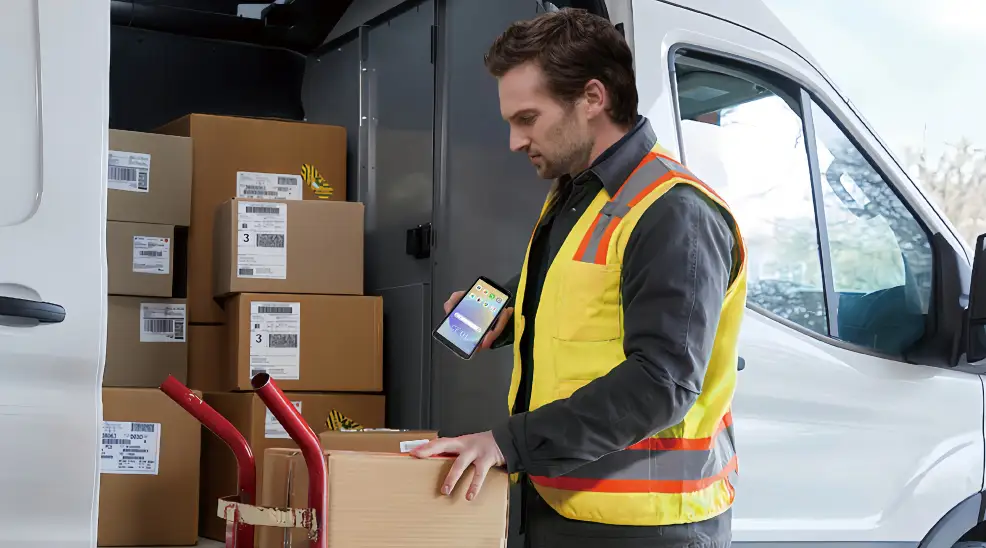
Industrial-Grade Handheld Terminal/Rugged Tablet: The "mobile workstation" for delivery personnel, inspectors, and warehouse staff. Features include barcode/QR code scanning, RFID reading, HD camera, fingerprint/NFC recognition, etc., used for electronic waybill signing, inventory counting, inspection check-ins, etc. Their ruggedness suits harsh outdoor environments.
AI Dashcam: Integrates ADAS (Advanced Driver-Assistance Systems) and DSM (Driver Status Monitoring), using computer vision to monitor forward collisions, lane departures, driver fatigue/distraction, etc., proactively preventing risks.
2.2 Software Systems: The Intelligent Brain
Cloud Fleet Management Platform (Web): The manager's "command center." Presents a centralized view of the entire fleet, alarm center, fuel consumption reports, driving behavior analysis, maintenance schedules, etc., via a visual dashboard.
Driver Mobile Application (App): The link connecting drivers to the platform. Provides functions like navigation tasks, electronic log uploading, expense reporting, and instant messaging, simplifying driver operations.
2.3 Communication Technologies: The Unblocked Veins
4G/5G Cellular Networks: Provide the main wide-area, high-speed data transmission, ensuring low-latency return of real-time vehicle tracking data.
Low-Power Wide-Area Network (e.g., NB-IoT): Suitable for long-term monitoring of power-sensitive, low-data-volume sensors (e.g., temperature, door switches).
Satellite Communication: Serves as supplementary communication assurance in areas without terrestrial network coverage (e.g., remote mountainous areas, long-haul routes).
3. How Key Technical Functions Drive Efficiency Improvement
3.1 Real-Time GPS Tracking & Geofencing: From "Vague" to "Precise"
Functional Value: Displays all vehicle positions, speed, and direction in real-time on a map. Sets geofences to trigger automatic alerts when vehicles enter/exit predefined areas (e.g., customer addresses, warehouses, restricted zones).
Efficiency Gain: Improves dispatch response speed; verifies transport route compliance; automatically records arrival/departure times, providing basis for billing and assessment.
3.2 Driver Behavior Monitoring & Analysis: From "Passive" to "Proactive"
Functional Value: The system automatically scores and flags events like harsh acceleration, harsh cornering, harsh braking, speeding, and idling. Can correlate with video evidence.
Cost Savings: Promotes safer driving, directly reducing fuel consumption by approx. 10-20%; reduces vehicle component wear, lowering maintenance costs; decreases accident rates and insurance premiums.
3.3 Vehicle Health Status Monitoring: From "Reactive Repair" to "Preventive Maintenance"
Functional Value: Monitors engine fault codes, battery voltage, tire pressure, oil life, etc., via CAN bus or external sensors.
Cost Savings: Predictive maintenance prevents minor issues from becoming major repairs; schedules maintenance, reducing unplanned vehicle downtime; extends overall vehicle lifespan.
3.4 Route Optimization & Intelligent Dispatch: From "Empiricism" to "Data-Driven"
Functional Value: The platform uses algorithms to dynamically plan optimal delivery sequences and routes based on real-time traffic, vehicle locations, cargo attributes, and customer time windows.
Efficiency Gain: Shortens average delivery time; increases deliveries per vehicle per day; reduces total mileage and empty load rates. A core tool for reducing logistics fleet operating costs.
3.5 Digitalization & Paperless Operations: From "Manual" to "Automatic"
Functional Value: Handheld terminals are used for order receiving, cargo scanning, electronic proof of delivery, photo evidence. Data syncs automatically to the backend.
Efficiency Gain: Eliminates duplicate data entry, reducing errors; speeds up freight settlement cycles (from days to real-time); enhances customer experience and brand professionalism.
4. Practical Guide to Implementation and Deployment
The key to successful implementation lies in smooth transition and deep application.
4.1 Device Selection Criteria
Ruggedness (IP rating, drop resistance): Adapts to outdoor logistics environments.
Battery life & charging: Meets long operational hour requirements.
Functional suitability: Select sensors based on business scenarios (e.g., cold chain needs temperature monitoring, high-value goods need video monitoring).
Platform compatibility & openness (API): Ensures integration with existing TMS, ERP, etc.
Based on the key criteria above for evaluation, when selecting mobile devices for logistics fleets, to ensure the devices can meet the requirements for long-term stable operation in complex logistics environments. Let's take the SEUIC CRUISE2 5G rugged mobile computer as an example to explain its application in logistics fleet management in detail:
Ruggedness (IP rating, drop resistance): Devices must withstand the harsh demands of outdoor logistics environments. The CRUISE2 5G achieves an IP68 protection rating, effectively resisting common on-site dust and water splash impacts. Its military-grade drop resistance (withstanding 1.5-meter drops without damage) ensures stable operation in scenarios such as loading/unloading and vehicle vibrations, perfectly meeting the physical resilience requirements of logistics environments for equipment.
Battery Life & Charging Efficiency: Logistics operations are characterized by continuity and fast pace, requiring devices capable of all-weather operation. The CRUISE2 5G features a 5360mAh high-capacity battery supporting hot-swapping. Combined with low-power processor optimization, it enables continuous two-shift operation without power failure, effectively solving the pain point of traditional devices running out of power during peak hours.
Functional Suitability: Select appropriate functions based on business scenarios. Addressing diverse needs in fleet management, the CRUISE2 5G offers comprehensive solutions:
- 5G Network Advantage: High-speed 5G enables real-time transmission of vehicle trajectories, driver behavior, cargo status, ensuring timely and accurate information for the dispatch center.
- Precise Positioning: Supports GPS/BeiDou multi-positioning systems, providing reliable data for route optimization and ETA prediction.
- Data Acquisition Expansion: Rich interface design supportsExternal temperature, humidity sensors, meeting monitoring needs for special scenarios like cold chain logistics.
Platform Compatibility & Openness (API): Devices should integrate seamlessly with existing TMS, ERP, etc. The CRUISE2 5G, based on the open Android OS, provides comprehensive SDK and API interfaces for quick integration with existing enterprise management platforms, enabling two-way data sync and avoiding information silos.
Practical Application Scenario Validation:
In long-haul trunk transport, the CRUISE2 5G's 5G network ensures real-time transmission of video surveillance data and vehicle operation parameters.
In urban distribution, its ruggedness withstands the challenges of frequent getting on/off the vehicle and outdoor work.
In warehouse management linkage, functions like barcode scanning and RFID reading achieve data integration between transport and warehousing.
The SEUIC CRUISE2 5G rugged mobile computer, with its comprehensive advantages in network connectivity, environmental adaptability, functional completeness, and system integration, has become the preferred device for digital fleet management in many logistics enterprises, effectively supporting full-process digital management needs from transport dispatch to on-site operations.
4.2 System Integration "Three-Step Approach"
Pilot Operation: Select 1-2 typical routes or fleets for a pilot, verifying hardware stability and software functionality.
Phased Rollout: Optimize the plan based on pilot feedback, then deploy comprehensively in batches and regions.
Deep Integration: Use APIs to connect fleet management platform data with the company's core business systems, breaking down data silos.
4.3 Personnel Training and Change Management
Management: Training focuses on data interpretation and decision-making application.
Dispatchers: Train on operating the intelligent dispatch console and new workflows.
Drivers/Operators: Use simple tutorials to explain APP/terminal use, emphasizing the convenience and safety benefits the system brings.
Establish Incentive Mechanisms: Link safe driving scores and fuel savings to performance rewards to positively guide employee behavior.
5. Return on Investment (ROI) Analysis – Making Every Investment Justifiable
Investing in a fleet tracking solution is not a pure cost but a strategic investment with clear financial returns.
5.1 Cost Composition
One-time Investment: Hardware procurement costs, system installation/custom development fees.
Recurring Costs: Communication data fees, software annual fees, hardware maintenance costs.
5.2 Efficiency Improvement and Cost Savings Model
For a fleet with 50 medium-sized trucks and annual operating costs of approximately 15 million RMB, deploying the solution is expected to save in the following areas:
Fuel Costs: Save 8%-15% through standardized driving and route optimization, approx. 120,000 - 225,000 RMB/year.
Maintenance Costs: Reduce by 10%-20% through preventive maintenance and improved driving, approx. 150,000 - 300,000 RMB/year (assuming annual maintenance cost of 1.5 million RMB).
Labor & Dispatch Efficiency: Reduce dispatcher communication costs, increase vehicle utilization by 5%-10%, indirectly creating value.
Management Losses: Plug management loopholes related to fuel, mileage, and time.
The competition in logistics is essentially a competition in supply chain digitalization and management refinement. A mature mobile device solution provides not just points on a map, but a full-chain digital management system encompassing vehicles, drivers, cargo, and customers. It transforms uncertainty into controllable data and upgrades empirical decision-making to intelligent decision-making, ultimately achieving the dual goals of improving fleet management efficiency and reducing logistics fleet operating costs.
- Demystifying Manual Traceability Pains: How CRUISE2 5G Enables Barcode-Based Bidirectional Traceability2026-04-03
- Demystifying Slow Backroom Transfers: How UTouch 2-S Enables Second-Level Inventory Navigation2026-04-03
- Demystifying Quality Control Bottlenecks: How RFID Moves Towards Proactive Prevention2026-04-02
- How Handheld Computers Achieve End-to-End Traceability2026-04-02
- Demystifying Workstation Information Bottlenecks: How CRUISE2 5G Enables Paperless, Real-Time Operations2026-04-01