Brief Introduction
In the process of digitalization in the retail industry, daily store operations are increasingly reliant on terminal equipment. From goods receiving and inventory counting to checkout and settlement, handheld terminals have become core tools. However, the complexity of the retail store environment poses multiple challenges for equipment, and the shortcomings of traditional handheld terminals are becoming increasingly apparent. SEUIC's AUTOID 10 handheld terminal, based on the actual needs of retail scenarios, offers comprehensive optimization from hardware protection and battery life to management efficiency and network adaptability, making it a retail equipment choice that balances both "durability" and "intelligence."
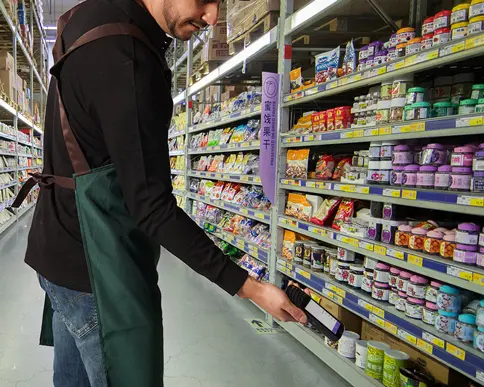
1. Insufficient Adaptation of Traditional Handheld Terminals: Multiple Operational Challenges Facing Retail Stores
The usage scenarios for equipment in retail stores are full of uncertainties, with pain points mainly concentrated in three dimensions:
1.1 High Risk of Equipment Damage. Stores have dense shelving and high foot traffic, making accidental drops, collisions with shelves somewhat common for handheld terminals. Combined with dust accumulation and water splashes during cleaning, traditional equipment suffers from high failure rates. This not only increases maintenance and replacement costs but may also affect critical operations like checkout and inventory counting due to equipment downtime.
1.2 Battery Life Struggles to Meet Business Needs. During peak hours, store business volume is concentrated. If terminals frequently run out of power, it leads to interrupted data recording and reduced checkout efficiency. The short battery life and lack of transparent battery status in traditional devices further exacerbate operational anxiety.
1.3 Low Multi-Store Management Efficiency. Chain retail brands often have multiple stores or distribution centers with decentralized equipment deployment. Traditional management models struggle to monitor equipment status in real-time and configure applications uniformly, leading to high management costs and delayed responses. Furthermore, some stores have areas with weak network signals, such as underground storage rooms or dead zones in the sales floor. Unstable device network connections can cause data synchronization delays, affecting inventory accuracy and operational continuity.
2. SEUIC AUTOID 10 Handheld Terminal Provides Targeted Solutions, Empowering Efficient Retail Store Operations with Multi-dimensional Advantages
Addressing the core pain points of retail stores, the SEUIC AUTOID 10 handheld terminal offers solutions through practical technical design.
In terms of protection performance, the device boasts an IP67 rating, effectively resisting dust ingress and low-pressure water jets. Even if dropped from a height of 1.8 meters onto concrete, it remains stable and operational, significantly reducing the probability of accidental damage and subsequent maintenance investment.
Regarding battery life, the AUTOID 10 has a built-in 5360mAh high-capacity battery and supports hot-swappable battery technology, ensuring long-lasting, continuous operation without interruption, fully covering the business needs of retail stores from morning market opening to store closing. Simultaneously, the device features efficient power management functions, allowing real-time monitoring of battery status to prevent operational disruptions caused by sudden power loss.
Improved management efficiency is another highlight. The device supports advanced connectivity and cloud service platforms. Store managers can use remote monitoring and batch configuration functions to track device status and distribute applications. Whether managing multiple terminals across chain stores or troubleshooting equipment in distribution centers, it enables visual, centralized operations, significantly reducing labor costs and improving usage efficiency.
In terms of network adaptability, the AUTOID 10 is equipped with Wi-Fi 6 Ready technology, offering stronger anti-interference capabilities and low-latency characteristics (latency as low as 3-4ms). Even in areas with weak network signals like underground storage rooms or store corners, or during mobile operations, it maintains a stable connection. This ensures real-time synchronization of product data and inventory information with the backend system, preventing business interruptions or data discrepancies.
From an application scenario perspective, the device is suitable not only for high-frequency use environments like fresh food supermarkets and clothing stores but also for complex environments such as low temperatures in cold chain storage or outdoor temporary stalls. It also meets the multi-device management needs of chain stores and distribution points, making it a practical tool for various scenarios in the retail industry.
The SEUIC AUTOID 10 handheld terminal, with its core advantages of being "Durable, Long-lasting, and Easy-to-Manage," accurately matches the actual operational needs of retail stores. Through the synergistic optimization of hardware and software, it supports the efficient utilization of store equipment assets, helping retail enterprises achieve more stable and efficient daily operations.
As a professional manufacturer of data collection terminal equipment, SEUIC has been focusing on the research and development of products such as handheld terminal PDAs, industrial barcode scanners, RFID readers, and fixed scanners for years. Leveraging rich design and production experience in the industrial-grade 4G/5G terminal field and relying on highly reliable product capabilities and efficient services, our products have been widely used in manufacturing, retail e-commerce, logistics and express delivery, healthcare, and public utilities.
- Demystifying Manual Traceability Pains: How CRUISE2 5G Enables Barcode-Based Bidirectional Traceability2026-04-03
- Demystifying Slow Backroom Transfers: How UTouch 2-S Enables Second-Level Inventory Navigation2026-04-03
- Demystifying Quality Control Bottlenecks: How RFID Moves Towards Proactive Prevention2026-04-02
- How Handheld Computers Achieve End-to-End Traceability2026-04-02
- Demystifying Workstation Information Bottlenecks: How CRUISE2 5G Enables Paperless, Real-Time Operations2026-04-01