Brief Introduction
In the fast-paced, high-demand modern manufacturing industry, quality control (QC) has long surpassed the scope of "post-production sampling inspection." It has evolved into a "nervous system" that runs through the entire product lifecycle. However, for many factory managers, production supervisors, and quality inspectors, this "nervous system" is often shrouded in "information fog": paper documents are prone to errors and loss, data entry lags, and problem tracing is like looking for a needle in a haystack... This not only affects production efficiency but may also put a company's brand reputation at risk.
Today, a digital transformation driven by industrial handheld computers (also known as industrial handheld terminals, industrial PDAs) is thoroughly clearing away this fog. It is not just a tool to replace paper and pen; it is a key intelligent node connecting the physical world with digital systems, enabling precise inspection and full-process traceability. This article will delve into how handheld computers reshape the closed loop of quality control and provide you with a practical guide.
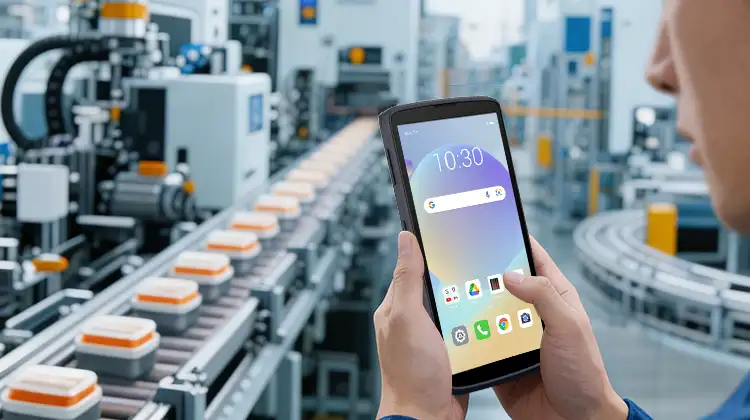
1. Confronting the "Information Fog" of Traditional Quality Control: The Dual Dilemma of Efficiency and Accuracy
Before introducing handheld computers, the quality control processes of many enterprises relied on manual recording and post-event data entry, leading to several typical pain points:
Information Lag and Data Silos: Inspection data was recorded on paper and required secondary entry into ERP/MES systems, causing delays in information updates. Management could not grasp the real-time quality status of production lines.
High Rate of Human Error: Manually transcribing lengthy material batch numbers, serial numbers (SN), and inspection results was highly prone to errors and omissions. A single digit deviation could render the traceability of an entire batch of products ineffective.
Low Traceability Efficiency: When product complaints arose or recalls were needed, finding all production, inspection, and warehousing records for a specific batch from piles of paper records was time-consuming, labor-intensive, and accuracy could not be guaranteed.
Lack of Process Monitoring: It was difficult to conduct standardized, recordable data collection for process quality parameters like assembly and inspections, heavily relying on personnel experience and leading to poor consistency.
These pain points collectively constitute the "black box" of quality management, and handheld computer quality control is precisely the key to opening this black box.
2. Handheld Computers: How Do They Reshape the "Data Collection - Processing - Decision" Closed Loop of Quality Control?
Industrial handheld computers seamlessly connect all aspects of quality control through their rugged hardware and flexible software, forming a real-time, precise, and traceable intelligent closed loop.
2.1 Accurate and Efficient Data Collection
This is the starting point of the closed loop. Handheld computers integrate high-performance 1D/2D barcode scanning engines, RFID read/write modules, and even vision recognition systems. Inspectors only need to "scan" to instantly and error-free collect material codes, process codes, equipment codes, employee IDs, and product serial numbers. This fundamentally eliminates manual input errors, improving efficiency by over 50%.
2.2 Real-Time, Online Data Processing and Judgment
Via Wi-Fi/4G/5G networks, handheld computers connect in real-time to the enterprise's MES (Manufacturing Execution System), QMS (Quality Management System), or ERP. After scanning, data is uploaded immediately. The system can retrieve the product's process standards and inspection specifications in real-time and display them clearly on the handheld computer screen. After the inspector inputs measured data (such as dimensions, voltage, appearance photos), the system can instantly and automatically judge pass/fail and prompt the next operation, achieving "inspection equals decision."
2.3 Structured, Traceable Data Archiving
All inspection results, operators, time/location, and equipment parameters are automatically stored in the central database in structured data format. Each product possesses a complete, immutable "digital life history," laying a solid foundation for full-process quality traceability.
2.4 Visualized, Intelligent Data-Driven Decision Making
The backend system performs statistical analysis on the gathered massive quality data, generating real-time reports, SPC control charts, and quality dashboards. Managers can gain insight into the first-pass yield and defect distribution trends of various production lines at any time, thereby achieving a shift from "post-event correction" to "pre-event prevention."
3. Practical Application of Handheld Computers in Four Core Scenarios of Quality Control
Handheld computers have extremely wide applicability, covering almost all industries involving the flow of physical goods and information. The following details four core application scenarios in combination with your target audience:
Scenario 1: Discrete Manufacturing and Production Quality Inspection
Incoming Quality Control (IQC): Scan supplier material barcodes, retrieve purchase orders and inspection standards in real-time, quickly complete sampling inspections and result entry. Non-conforming products can immediately trigger the return process。
In-Process Quality Control (IPQC): At key workstations on the production line, scan the product routing sheet and complete specified inspection items (such as torque value, welding quality photos) according to MES instructions, ensuring process control.
Final Quality Control / Outgoing Quality Control (FQC/OQC): Perform comprehensive inspection of finished products. Scan multiple product barcodes (e.g., SN code, nameplate code, equipment code) and compare them with system orders to ensure 100% correctness of product, configuration, and packaging.
Repair and Rework: Scan the non-conforming product barcode to automatically retrieve repair guidance solutions, record fault phenomena and replaced components, forming a complete repair history.
Scenario 2: Warehouse Logistics and Traceability Management
Inbound/Outbound Quality Inspection: During receiving and shipping, quickly scan pallet or individual item barcodes using a handheld computer to verify quantity and quality status, achieving precise inventory management.
Warehouse Inventory Counting and Transfer: Quickly scan location and goods barcodes, update inventory records in real-time, ensuring consistency between book and physical stock.
End-to-End Traceability: Data for every movement, operation, and inspection from raw material receiving to finished goods shipping is recorded. If needed, the entire flow of a specific batch of products can be traced instantly.
Scenario 3: Retail and Product Inspection
Product Price Tag Inspection: The inspector scans the product barcode, and the handheld computer screen immediately displays the system's standard price and promotional information for quick comparison with the physical price tag, ensuring accuracy.
Shelf Display and Expiry Date Checking: Scan products, check if the display matches the planogram, and record the production date. Automatically alert for near-expiry products, enhancing store operation standardization.
Scenario 4: Field Inspection and Public Services
Equipment Inspection and Meter Reading: Upon arriving at the site, inspection personnel scan the equipment QR code, retrieve historical inspection records and the current task list, input detection data (such as pressure, readings, appearance status), and can operate the touchscreen with gloves on or in rainy conditions. Data is transmitted back in real-time.
On-Site Law Enforcement and Inspection: Scan certificates or vehicle information, query the database in real-time, input inspection results on-site, and issue electronic documents, improving law enforcement efficiency and standardization.
4. Born for Harsh Industrial Environments: Key Selection Criteria for Quality Inspection Dedicated Handheld Terminals
Not all handheld devices are capable of handling industrial quality inspection tasks. When selecting a dedicated industrial handheld terminal, the following points require special attention:
Ruggedness and Protection Rating: Must withstand multiple drops from height (usually compliant with MIL-STD-810G military standard), prevent dust ingress (dustproof IP6X), and withstand water immersion (IP67/IP68) to adapt to complex environments like workshops, warehouses, and outdoors.
Excellent Data Capture Capability: The scanning engine is crucial. It must easily read damaged, soiled, high-density, reflective, long-range, or miniaturized 1D/2D barcodes. Some scenarios also require consideration of RFID or vision recognition functions.
Long Battery Life and Hot-Swappable Battery: Must support continuous high-intensity operation for 8-12 hours or more. A hot-swappable battery is an important feature, allowing battery replacement without shutting down the device, ensuring 7x24 hour uninterrupted operation.
Efficient Overall Performance and Display: Processor performance must be sufficient to run business apps smoothly; the screen must be clearly visible under strong light and support operation with gloves and wet hands.
Seamless System Integration Capability: The device must provide rich SDKs and open interfaces to enable deep integration with the enterprise's existing MES, ERP, WMS, and other systems. This is the technical foundation for achieving the data closed loop.
5. Success Practice: How TW Solar Utilizes CRUISE2 for Quality Control and Inspection
The case of TW Solar, a global leader in the photovoltaic industry, perfectly illustrates the core value of industrial handheld computers in quality control. On the solar panel production line, every finished module must undergo strict quality inspection, requiring the accurate collection of data from multiple barcodes such as module codes, product nameplate codes, and machine codes, and comparison with order information in the MES system to determine pass/fail.
In the past, they relied on manual visual verification of lengthy SN numbers. The process was cumbersome and highly prone to errors and omissions, becoming a bottleneck for efficiency and reliability. To solve this pain point, TW Solar introduced the SEUIC CRUISE2 industrial mobile computer.
The effectiveness of this solution is significant:
Accurate Collection: The powerful scanning engine of the CRUISE2 can easily and quickly identify multiple barcodes on solar panels from different angles, including low-contrast and miniaturized barcodes, ensuring 100% accuracy in data capture.
Real-Time Determination: Scanned data is transmitted to the MES system in real-time. The system immediately compares and returns pass/fail results, which the inspector can obtain on the spot, achieving seamless process linkage.
Efficiency Leap: The efficiency of the entire quality inspection process increased by over 50%, manpower was liberated, and production bottlenecks were overcome.
Zero Errors: Completely eliminated errors and omissions caused by manual verification, elevating the reliability of quality inspection to a new level, providing solid data assurance for TW Solar to maintain its industry-leading position.
This case clearly demonstrates that choosing the right industrial handheld computer is not merely purchasing a device; it is a digital transformation of the quality control process, directly leading to an exponential improvement in efficiency and accuracy.
In today's increasingly competitive manufacturing industry, quality is not just a product standard but a reflection of a company's core competitiveness. As a bridge connecting the physical and digital worlds, industrial handheld computers, by enabling accurate, real-time, and traceable data collection and processing, are transforming quality control from a cost center reliant on manpower and experience into a value center driving continuous improvement and intelligent decision-making.
Founded in 2002, SEUIC Technologies Co., Ltd. has been committed to grasping core technologies, enhancing technological innovation, providing excellent self-owned brand products, including mobile computers, RFID readers, tablets, barcode scanners and fixed readers. With highly reliable products and efficient services, our products have been widely used in manufacturing, retail, logistics & transportation, healthcare and other industries. We provide frontline workers more durable real-time data collection tools, helping you do more thereby to catapult your productivity to the next level.
- Demystifying Manual Traceability Pains: How CRUISE2 5G Enables Barcode-Based Bidirectional Traceability2026-04-03
- Demystifying Slow Backroom Transfers: How UTouch 2-S Enables Second-Level Inventory Navigation2026-04-03
- Demystifying Quality Control Bottlenecks: How RFID Moves Towards Proactive Prevention2026-04-02
- How Handheld Computers Achieve End-to-End Traceability2026-04-02
- Demystifying Workstation Information Bottlenecks: How CRUISE2 5G Enables Paperless, Real-Time Operations2026-04-01