Brief Introduction
In the wave of global digital and intelligent transformation in the home appliance manufacturing industry, product lifecycle traceability has become the cornerstone of quality management. However, at actual home appliance assembly stations, the "high reflection" phenomenon caused by metal casings, stainless steel linings, and various chrome-plated accessories has long been a "disaster zone" for barcode reading. When faced with Direct Part Marking (DPM) codes, traditional scanning equipment often suffers from issues like image overexposure and loss of contrast due to light scattering, severely impacting production efficiency.
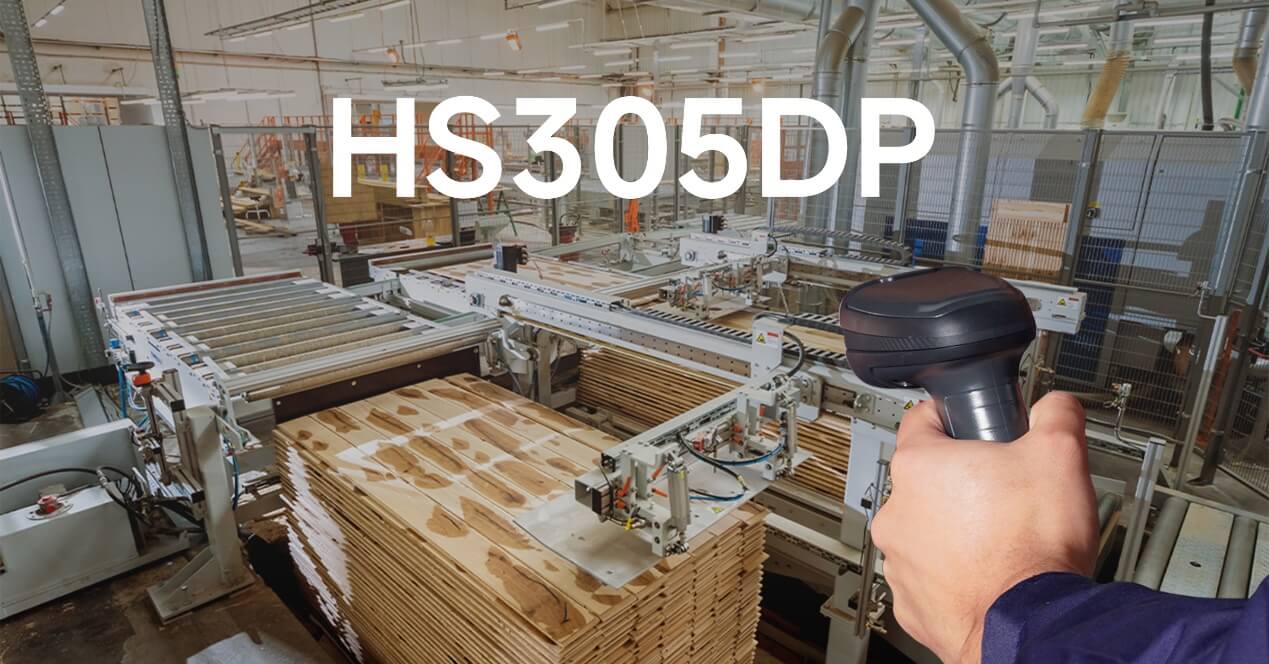
Today, we will use the SEUIC HS305DP AI Industrial Wired Barcode Scanner as an example to analyze the synergistic logic of three-color lighting technology and AI algorithms, exploring how to solve complex code reading challenges in home appliance assembly scenarios.
1. What Exactly Makes Reading DPM Codes in Home Appliance Assembly So Difficult?
Home appliances like refrigerators, washing machines, and air conditioners extensively use metal materials and high-gloss surface finishes. To achieve permanent product traceability, manufacturers typically generate QR codes directly on component surfaces via methods like laser etching or pin marking. However, this "direct marking" method faces three core pain points in actual production:
High Reflection Interference: Aluminum alloy housings and stainless steel panels act like mirrors. Direct light creates glaring hotspots that directly obscure code features, preventing device recognition.
Low Contrast Challenge: On graphite materials or some dark resin surfaces, the color difference between the code and background is minimal. Conventional light sources struggle to extract code edge information, drastically reducing recognition success rates.
Geometric Variation Impact: Automotive-grade appliance components, compressor pump bodies, etc., often have curved surfaces, causing the code to appear stretched or deformed in visual imaging, further increasing reading difficulty.
2. SEUIC HS305DP Industrial Scanner's Three-Color Intelligent Switching: Precisely Solving Pain Points at the Physical Level
Addressing the pain points caused by material differences in home appliance components, the SEUIC HS305DP AI Industrial Wired Barcode Scanner is equipped with an intelligently adjustable diffuse light source system, featuring three color temperature light sources: red, white, and blue. This is not merely color addition but industrial-grade precision design based on optical complementary principles, providing "targeted solutions" for different scenarios:
2.1 Blue Area Light: The "Nemesis" of Curved Surfaces and High Reflections
Blue light has a shorter wavelength and higher scattering rate, effectively dispersing light and preventing hotspot formation. In home appliance assembly, when facing metal curved surfaces (e.g., laser codes on glossy curved metal), the blue area light precisely suppresses noise from specular reflection, presenting sharper code patterns to the sensor, easily capturing clear code features.
2.2 Red Area Light: The "Contrast Enhancer" for Dark Backgrounds
The red light source is specifically suited for reading codes on dark backgrounds or surfaces with uneven contrast. For example, on black resin surfaces or copper foil parts with anti-rust oil coatings, red light significantly enhances the contrast between the code area and the background, ensuring the CMOS sensor clearly captures the binary features of the code, preventing recognition failures due to insufficient contrast.
2.3 White Spot Light: The "Efficiency Guarantee" for General Scenarios
For the most common laser-etched codes on flat metal surfaces in production lines, the white spot light provides balanced spectral coverage, quickly locating code positions and improving reading efficiency. It serves as the basic configuration ensuring efficient flow in conventional production lines, balancing practicality and stability.
3. SEUIC HS305DP Industrial Scanner's AI Algorithm + Dual-core Processor: Making Reading Faster and More Accurate
Beyond optimizing physical lighting, the built-in dual-core processor and AI algorithm of the SEUIC HS305DP further enhance the device's response speed and recognition accuracy, achieving "millisecond-level" efficient reading to meet the high-speed production demands of home appliance assembly lines:
3.1 Precise Localization in Complex Backgrounds
The AI algorithm can quickly filter out interference factors like metal textures, part wear marks, and PCB via holes, accurately locking onto the code area, avoiding misreads and missed reads.
3.2 Dynamic Scanning Without Blur
Paired with a CMOS sensor featuring a global shutter, it effectively avoids the "rolling shutter effect" when scanning dynamically moving workpieces, ensuring the integrity of each frame, suitable for dynamic assembly line scenarios.
3.3 High-Precision Full Coverage
Supports high-precision reading of 1D codes down to 3mil and 2D codes down to 5mil. Even when facing miniature DPM codes on precision home appliance parts, it can read them effortlessly, providing full coverage for production needs.
4. Scenario-based Implementation: Beyond Home Appliances, Covering Core Links in Multiple Fields
Currently, the SEUIC HS305DP AI Industrial Wired Barcode Scanner is widely used on home appliance assembly lines and also covers multiple associated core links, becoming an "all-around code reading assistant" in industrial production:
Home Appliance Lithium Battery Modules: Accurately reads miniature DPM codes on copper foil surfaces and aluminum casings, ensuring traceability of battery components.
Home Appliance 3C Electronics and PCB Components: Stably reads laser codes on reflective, uneven black resin surfaces, suitable for reading codes on precision components like appliance control boards.
Automotive-grade Home Appliance Components: Easily reads pin-marked codes on cast iron parts and glossy surface barcodes on curved metal, meeting the code reading needs for high-end appliance accessories.
Through the deep integration of three-color lighting technology and AI vision algorithms, the SEUIC HS305DP has successfully overcome the reading barriers caused by material diversity in home appliance manufacturing. This solution, which balances ergonomic design with industrial durability, not only solves practical pain points on the production front line but also provides solid hardware support for the flexible and intelligent production of the home appliance industry, aiding the high-quality transformation of home appliance manufacturing.
Founded in 2002, SEUIC Technologies Co., Ltd. has been committed to grasping core technologies, enhancing technological innovation, providing excellent self-owned brand products, including mobile computers, RFID readers, tablets, barcode scanners and fixed readers. With highly reliable products and efficient services, our products have been widely used in manufacturing, retail, logistics & transportation, healthcare and other industries. We provide frontline workers more durable real-time data collection tools, helping you do more thereby to catapult your productivity to the next level.
- Demystifying Manual Traceability Pains: How CRUISE2 5G Enables Barcode-Based Bidirectional Traceability2026-04-03
- Demystifying Slow Backroom Transfers: How UTouch 2-S Enables Second-Level Inventory Navigation2026-04-03
- Demystifying Quality Control Bottlenecks: How RFID Moves Towards Proactive Prevention2026-04-02
- How Handheld Computers Achieve End-to-End Traceability2026-04-02
- Demystifying Workstation Information Bottlenecks: How CRUISE2 5G Enables Paperless, Real-Time Operations2026-04-01