Brief Introduction
Are barcodes printed on lithium battery aluminum-plastic film difficult to read due to reflectivity and wrinkles, affecting production yield? The SEUIC X4 AI Industrial Fixed Reader, with its AI intelligent algorithm, 1.3-megapixel global shutter, and IP67 protection, accurately reads complex barcodes, achieving zero missed reads, and helps improve quality and efficiency in lithium battery production lines.
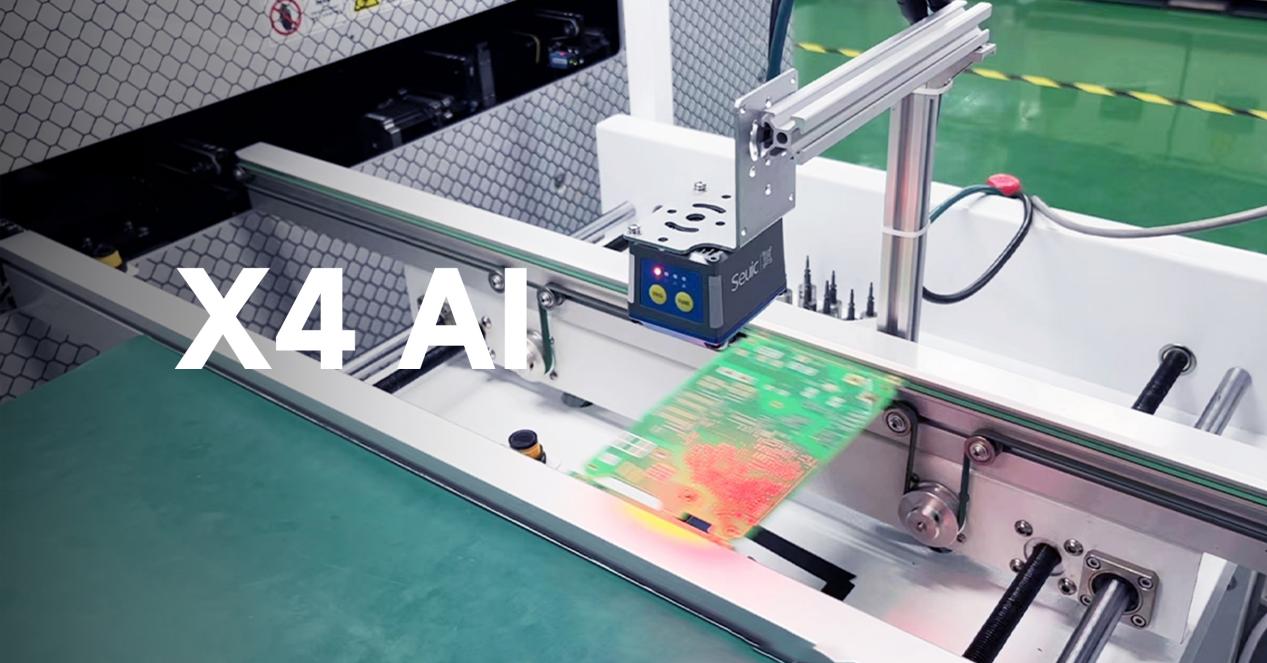
1. Aluminum-Plastic Film Barcode Reading: The "First Pass" for Lithium Battery Quality Traceability
In the lithium battery manufacturing process, aluminum-plastic film serves as a key material for cell encapsulation. The traceability codes printed on its surface carry the "identity information" and full lifecycle data of the cell. However, the inherent high reflectivity of aluminum-plastic film material, inevitable minor wrinkles during production, and the stringent real-time requirements of high-speed production lines for barcode reading make this stage the "Waterloo" for traditional Fixed Readers. Barcode reading failures not only lead to point data loss but may also cause batch traceabilityin interrupt, yield statistics distortion, and even the risk of scrapping an entire batch of cells. The SEUIC X4 AI Industrial Fixed Reader, with its leading AI vision technology and industrial-grade performance, is redefining the reliability standard for barcode reading on lithium battery aluminum-plastic film, building a solid line of defense for improving production yield.
2. Technical Challenges of Aluminum-Plastic Film Barcode Reading: Why Do Traditional Devices Frequently Fail?
High reflectivity interference: The smooth, mirror-like surface of aluminum-plastic film easily produces intense glare, drowning out low-contrast printed code information.
Dynamic deformation: Minor wrinkles generated during film material transmission and forming cause geometric distortion of QR codes.
Small code size: Codes printed on aluminum-plastic film are small (often requiring reading of small 2D codes), placing extremely high demands on the reader's resolution.
Harsh environment: Production lines have dust and vibration, requiring equipment to have industrial-grade protection and stability.
3. Technological Breakthrough: The Core Advantages of the SEUIC X4 AI
3.1 Imaging Core: Global Shutter Captures High-Speed Dynamic Moments
The SEUIC X4 AI Industrial Fixed Reader is equipped with a 1.3-megapixel global shutter CMOS image sensor. This configuration is crucial for high-speed moving aluminum-plastic film barcode reading scenarios on lithium battery production lines. Compared to traditional rolling shutter, the global shutter can expose the entire image at once, completely eliminating image distortion and motion blur caused by high-speed material movement or production line vibration, ensuring every frame is sharp and clear, laying a solid foundation for subsequent precise decoding.
3.2 Decoding Capability: Small Codes and Complex Code Types Have Nowhere to Hide
To address the characteristics of small print size and diverse code types (primarily 2D codes like DataMatrix) on aluminum-plastic film, the X4 AI supports reading the full range of 2D codes including QR, DataMatrix (ECC200), and PDF417, with a resolution as high as 2.0 mil. This means that even micro traceability codes printed on the edge of the aluminum-plastic film, as small as a fingernail, can be stably and accurately captured and parsed, fundamentally eliminates missed-read problems caused by excessively small codes.
3.3 Lighting Adaptation: Multi-Spectral Combination Conquers the Reflectivity Challenge
The mirror-like reflectivity of aluminum-plastic film is the number one culprit for barcode reading failures. The X4 AI is equipped with adjustable white or red LED lighting source, and supports special models with customized blue LED. This design allows the device to flexibly choose the optimal spectral combination based on the color, reflectivity characteristics of different batches of aluminum-plastic film, and on-site ambient light, effectively suppressing glare interference and significantly improving imaging clarity for low-contrast printed codes.
3.4 Intelligent Algorithm: AI Chip Empowers "Zero-Debugging" Self-Adaptation
The core breakthrough of the X4 AI lies in its built-in AI chip and deep learning algorithm. It no longer relies on manual, repeated adjustments of parameters such as exposure and gain. Instead, it can analyze the reflectance intensity, contrast distribution, and code type characteristics in each frame of the image in real-time, automatically adapting the optimal imaging and decoding parameters within milliseconds. This means that regardless of changes in production line lighting or the complexity of film surface wrinkles, the X4 AI can achieve stable performance akin to "plug-and-play," significantly lowering the thresholds for deployment and maintenance.
3.5 Industrial Protection: IP67 Rating Ensures All-Weather Reliable Operation
Lithium battery production line environments are complex, with factors such as dust, electrolyte volatilization, and temperature fluctuations constantly testing the reliability of equipment. The X4 AI boasts an ultra-high IP67 protection rating, which completely prevents dust ingress and allows it to remain unscathed during brief immersion or coolant splash. Coupled with a wide operating temperature range of 0°C to 50°C, it ensures the device can continuously and stably output high-quality code reading results 24/7 in harsh industrial settings.
3.6 Communication Integration: Industrial Protocols Seamlessly Interface with MES Systems
As a data collection node for smart factories, the X4 AI supports mainstream industrial communication protocols such as TCP/IP, Profinet, EtherNet/IP, and ModBusTcp. This means it can be easily and seamlessly integrated into the MES (Manufacturing Execution System) of lithium battery enterprises, uploading every successfully read traceability code in real-time, achieving precise binding of cell identity and process parameters, and providing reliable data support for full lifecycle traceability.
4. Practical Application: How Does X4 AI Empower Aluminum-Plastic Film Production Lines
In key processes such as the forming and encapsulation of lithium battery aluminum-plastic film, the deployment of the SEUIC X4 AI delivers significant value:
Overcoming the reflectivity challenge: Leveraging AI algorithms to intelligently suppress specular reflection, in conjunction with adjustable lighting, ensures printed codes remain clearly readable even under strong ambient light.
Adapting to dynamic production lines: The global shutter sensor, paired with millisecond-level processing speed, perfectly matches high-speed line movement, maintaining a barcode reading success rate of over 99.9%.
Enabling data integration: Through industrial protocols such as Profinet and EtherNet/IP, barcode reading results are synchronized in real-time to the MES, achieving precise binding of cell identity to process parameters.
Reducing maintenance costs: The IP67 protection rating ensures long-term device reliability in environments with dust and coolant splash, minimizing downtime for maintenance.
5. Value Presentation: How Does Precise Barcode Reading Translate into Yield Improvement
Deploying the SEUIC X4 AI industrial code reader brings lithium battery enterprises not only improvement in the barcode reading process but also systemic benefits:
Yield improvement: Eliminates batch information loss or misjudgment caused by barcode reading failures at the source, increasing the full-process traceability completeness rate of cells to 100%, thereby indirectly enhancing product yield.
Efficiency optimization: Reduces the need for manual re-inspection and data re-entry, increasing the Overall Equipment Effectiveness (OEE) of the production line by 5%-10%.
Cost reduction: Lowers the risk of material scrappage due to traceability chain breaks, and decreases quality-related complaints and recall costs.
Data value-added: Provides a complete and reliable manufacturing data foundation for process optimization and defect analysis.
In today's lithium battery industry, which pursues ultimate efficiency and quality, the reliability of every production step is crucial to the competitiveness of the final product. The SEUIC X4 AI industrial code reader, with its robust capabilities such as a 1.3-megapixel global shutter, AI intelligent algorithms, and IP67 industrial protection, precisely overcomes the challenge of barcode reading on aluminum-plastic film. It serves as a reliable bridge connecting the physical production and digital worlds. Choosing the X4 AI means opting for deterministic technology to build a solid defensive moat for the yield and traceability of your lithium battery production lines.
Founded in 2002, SEUIC Technologies Co., Ltd. has been committed to grasping core technologies, enhancing technological innovation, providing excellent self-owned brand products, including mobile computers, RFID readers, tablets, barcode scanners and fixed readers. With highly reliable products and efficient services, our products have been widely used in manufacturing, retail, logistics & transportation, healthcare and other industries. We provide frontline workers more durable real-time data collection tools, helping you do more thereby to catapult your productivity to the next level.
- Demystifying Manual Traceability Pains: How CRUISE2 5G Enables Barcode-Based Bidirectional Traceability2026-04-03
- Demystifying Slow Backroom Transfers: How UTouch 2-S Enables Second-Level Inventory Navigation2026-04-03
- Demystifying Quality Control Bottlenecks: How RFID Moves Towards Proactive Prevention2026-04-02
- How Handheld Computers Achieve End-to-End Traceability2026-04-02
- Demystifying Workstation Information Bottlenecks: How CRUISE2 5G Enables Paperless, Real-Time Operations2026-04-01